
From Smart Ports to Thinking Ports
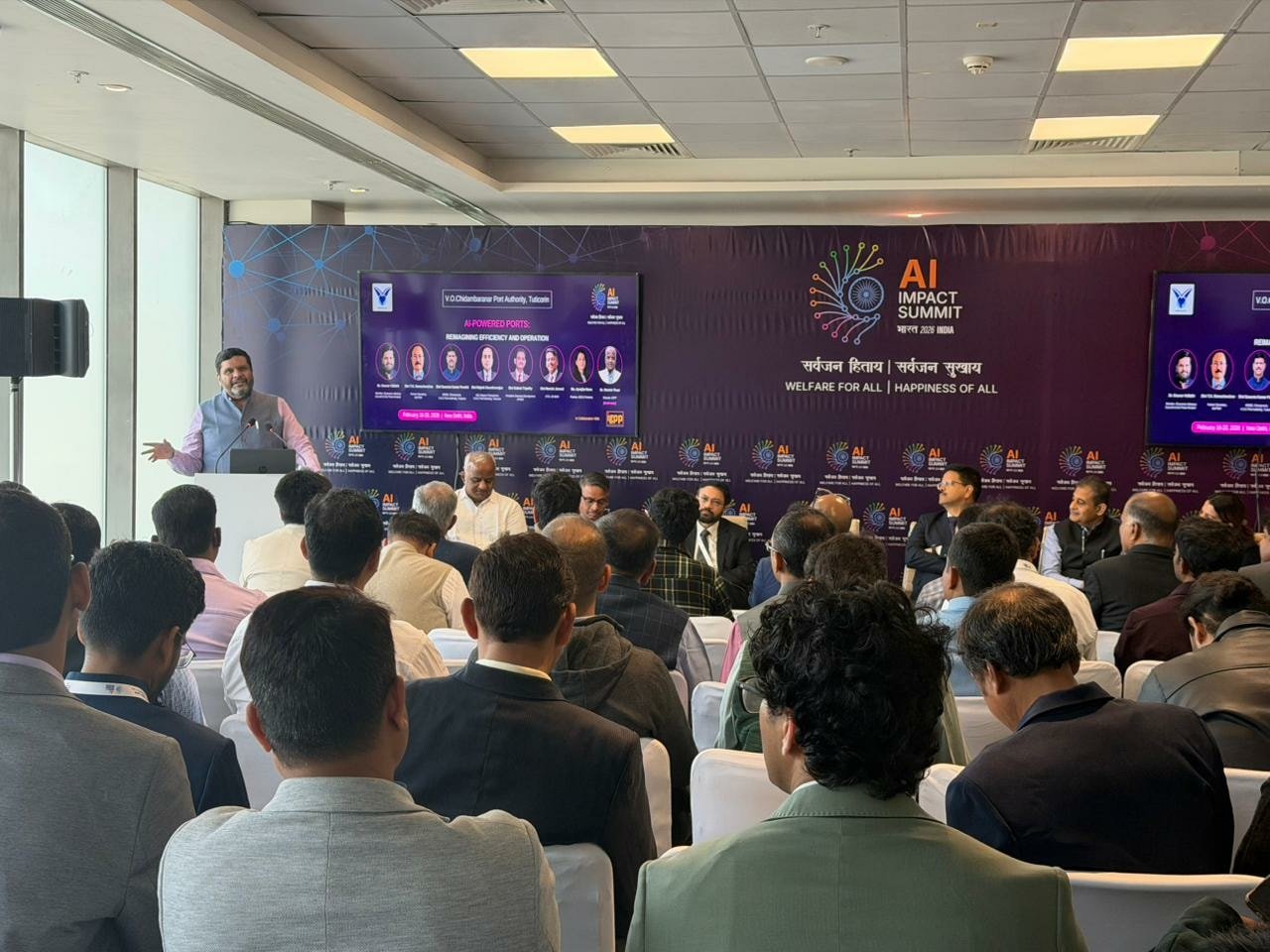
courtesy: Prof. Gourav Vallabh (Facebook)
India's major ports handled 855 million tons of cargo in FY25. The physical infrastructure is substantial and growing, with new developments at Vizhinjam, Vadhavan, and the Nicobar International Container Trans-shipment Port expanding the national footprint. Average capacity utilisation, however, sits at roughly 50%. Dwelling times run 2.5 times higher than the global best practice. Vessel turnaround is twice as slow. Crane productivity is half of what the best-performing ports achieve internationally.
These are not infrastructure but intelligence deficits. The machinery exists. The integration layer that would make it function as a system does not.
At the India AI Impact Summit 2026, a session on "AI-Powered Ports: Reimagining Efficiency and Operations," organised by V.O.C Port Authority in collaboration with the Institute for Governance, Policies and Politics, brought together policymakers, port operators, technology leaders, and legal practitioners to examine what AI can and should do for Indian maritime operations. The session surfaced a distinction that clarifies the challenge facing the sector: the difference between a smart port and a thinking port.
Smart Ports Have Technology. Thinking Ports Have Judgement.
T.K. Ramachandran, former Secretary of Shipping at the Ministry of Ports, Shipping and Waterways, laid out the distinction with precision. Smart ports, the kind India's major ports are becoming, have tech-led operations, automation, real-time visibility, and digital systems managing discrete functions. Thinking ports operate differently. They have decision-led operations, anticipatory visibility, system-wide integration, and intelligence that learns.
The shift he described moves along several axes simultaneously. From automation to judgement. From real-time monitoring to predictive planning. From siloed systems to cross-system frameworks. From repetitive processes to adaptive ones. AI in this framing is not about adding more technology to existing operations. It is about embedding technology in decision systems: what will happen, what should we do, and what is the right choice.
This distinction matters because India's ports have invested significantly in digitalisation over the past several years. Enterprise business systems are operational in half a dozen ports. NLP Marine, Sagar Setu, and E-Samudra are deployed. The One Nation, One Port process standardisation initiative was launched in March 2025. These are real accomplishments. They are also, by Ramachandran's assessment, the prerequisite layer, the digital infrastructure on which AI must be built, rather than the AI layer itself.
800 Documents, 200 Core, 60 Processes
Ramachandran shared a detail that illustrates the scale of the structural challenge. When the One Nation, One Port initiative examined documentation across India's major ports, it found over 800 different documents in use. After rationalisation, removing redundancies and identifying what was actually essential, the core set was reduced to approximately 200 documents. The processes behind them, customs, health, port operations, and various workflows unique to individual ports were consolidated into roughly 50 to 60 standardised processes.
This is the work that must happen before AI becomes meaningful. Eight hundred documents in fragmented formats across siloed systems is an environment where AI has nothing coherent to learn from. Two hundred core documents mapped to sixty standardised processes is an environment where pattern recognition, prediction, and decision support become possible.
The parallel to what we observe across every sector Mitochondria works in is direct. Organisations that attempt to deploy AI on top of unstandardised, fragmented operational realities consistently fail. The preparation layer, the structuring of information, the standardisation of processes, and the integration of data across silos, is where the real transformation happens. AI deployment is the forcing function that makes this structuring necessary and the reward that makes it worthwhile.
The Complexity of Multi-Stakeholder Operations
Subrat Tripathy, President of Business Development at APSEZ Ltd., expanded the picture by describing the operational complexity that any AI system must navigate. A port is not a single organisation performing a single function. It is a convergence point for vessels, agents, transporters, customs authorities, health inspectors, warehouse operators, and dozens of other stakeholders, each with their own systems, data, and decision processes.
Tripathy outlined five areas where AI can enter this complexity: design and planning (using digital twins for port layout and capacity modelling), operational impact (dynamic yard logistics, berth allocation, throughput maximisation), safety enhancement and risk management, quality assurance and customer interfacing, and global benchmarking. He described a concept of a virtual concierge for port operations, a platform that would bring all stakeholder interactions into a single, non-human-dependent interface, enabling vessels, agents, and transporters to interact through a unified system rather than through the fragmented channels that currently exist.
The global benchmarks are instructive. The Port of Rotterdam has used AI to reduce ship waiting times by 20%. Singapore's single-window systems optimise vessel calls through coordinated decision-making rather than individually taken decisions. These are not theoretical possibilities. They are operational realities in ports that have built the integration layer.
Tripathy also referenced the Ever Given incident in the Suez Canal, where 430 vessels were affected because the canal's operational systems could not anticipate or adapt to an anomalous event. AI-driven predictive systems for navigation, weather, and traffic flow could have provided the early warning and alternative routing that might have reduced the impact significantly. The point extends beyond individual incidents: ports that operate reactively will always be vulnerable to disruption. Ports that operate anticipatorily can absorb shocks and maintain throughput.
The Governance Layer Most Deployments Ignore
Ms Aprajita Rana of AZB & Partners introduced a dimension that most AI-for-industry conversations omit entirely: the legal architecture required when AI moves from advisory to autonomous functions.
Her analysis was specific and grounded. In port operations, multiple agencies are involved in every transaction. When a human makes a decision, accountability is clear, or at least attributable. When an AI system makes a decision, particularly in an environment where unanticipated scenarios are common, and consequences can be economic, environmental, or involve human safety, the question of liability becomes structurally complex.
Rana identified several gaps. Technology vendors typically protect themselves contractually with exclusions and indemnities, leaving the port operator bearing the majority of liability for AI-driven outcomes. India does not yet have an AI law that would provide a framework for attributing liability when autonomous systems cause harm. The explainability challenge, the ability to demonstrate why a particular AI decision was made, remains unresolved in most deployments. And the data quality problem compounds everything: if AI makes autonomous decisions based on data that is fragmented, incomplete, or unconsolidated across stakeholders, the reliability of those decisions is fundamentally compromised.
Her conclusion was measured: AI governance in port operations is not a nice-to-have. It is a structural requirement, particularly as the sector moves from predictive AI (which advises) toward prescriptive AI (which recommends actions) and eventually autonomous AI (which decides). Each step along that progression demands stronger governance, clearer accountability, and more rigorous audit mechanisms.
This perspective reinforced a theme that recurred throughout the India AI Impact Summit 2026: governance cannot be layered on after deployment. It must be architectural, embedded in the design of the system from the first conversation about what the system will do and who will be responsible when it does it.
The Economic Imperative
Prof. (Dr.) Gaurav Vallabh of the Economic Advisory Council to the Prime Minister framed the urgency in economic terms. India's logistics cost stands at 7.97% of GDP. The potential savings from AI adoption in port operations are estimated at approximately Rs 20,000 crore annually in cargo handling and Rs 15,000 crore in logistics costs. The country aims to be among the top 25 nations in logistics performance by 2030.
Vallabh's framing cut through the technology discussion to the fundamental point: the gap between India's port infrastructure and global benchmarks is both a competitiveness problem and an intelligence problem. Physical infrastructure and digital intelligence must develop together from day one. Retrofitting intelligence onto infrastructure built without it is possible but significantly more expensive and less effective.
His eight-point framework, structured around eight interpretations of "AI" (Available Infrastructure, Assessment Index, Actual Impediments, Authentic Integration, Automated Initiatives, Actual Investment, Avenues in India, and Accelerated Initiatives), provided a useful scaffolding for thinking about the sector's progression. The immediate priorities are automated gates, truck management systems, and predictive maintenance pilots. The medium-term targets are digital twins, AI-driven berth allocation, and AGV fleet expansion. The long-term vision encompasses fully automated terminals, autonomous vessel support, and hydrogen fuel adoption.
What connects all three horizons is the need for the integration layer that Ramachandran described and that the session consistently identified as missing. Without it, each initiative operates in isolation, delivering incremental gains but never compounding into the systemic intelligence that a thinking port requires.
How Mitochondria Approaches This Complexity
Port operations represent a category of challenge that Mitochondria's ATP framework was designed for: multi-stakeholder environments where data is fragmented across systems, processes vary between entities, decisions involve coordination across organisational boundaries, and the consequences of AI failure extend beyond the deploying organisation.
The pattern is consistent with what we see across manufacturing, financial services, and agriculture: the technology challenge is real but solvable, and it is consistently secondary to the organisational and informational challenge. An AI system deployed into a port where 800 documents exist in fragmented formats across siloed vendor systems will fail, regardless of how sophisticated the model is. An AI system deployed after the preparation work, the document rationalisation, the process standardisation, and the data integration has a foundation to learn from and a structure to operate within.
ATP for Logistics and Supply Chain begins with this preparation. The Stimuli phase maps the actual operational reality across stakeholders: what information moves between whom, in what format, through which systems, and where it breaks down. This mapping is where most deployments cut corners, and where most failures originate. The virtual concierge concept that Tripathy described, a unified stakeholder interaction layer, is architecturally aligned with how we design conversational intelligence for multi-party operational environments. The system meets each stakeholder where they are, in their language and on their preferred channel, while structuring every interaction into a coherent data layer that the organisation can learn from.
The governance requirements that Rana articulated, explainability, accountability, audit mechanisms, and contractual clarity, are built into ATP's architecture. Our systems operate via API, with no data stored on our side and encrypted transit only. Compliance with GDPR and DPDP is structural. Human-in-the-loop oversight is maintained throughout the progressive autonomy model: the system begins advisory, advances to prescriptive, and moves toward autonomous functions only when governance, reliability, and stakeholder confidence justify the transition.
The progression from predictive to prescriptive to autonomous AI that Dhruv Kotak of J M Baxi Group described as the sector's trajectory over the next two years is precisely the progression ATP is designed to manage. Each stage has different governance requirements, different risk profiles, and different organisational readiness demands. Building a system that can navigate all three stages, with appropriate controls at each, is the architectural challenge. It is also an opportunity.
Infrastructure and Intelligence Together
Prof. Vallabh's closing observation captures the sector's position precisely: infrastructure and intelligence should be together from day one. The physical investment in India's ports is substantial and accelerating. The intelligence investment, the integration layer, the governance architecture, and the decision systems that would transform smart ports into thinking ports are where the sector's competitive future will be determined.
The estimated Rs 35,000 crore in annual savings from AI adoption is significant. More significant is what those savings represent: ports that operate at closer to their actual capacity, that turn vessels around at globally competitive speeds, that allocate resources dynamically across terminals and yards, that predict disruptions before they cascade, and that coordinate dozens of stakeholders through intelligent systems rather than fragmented manual processes.
The wave metaphor that Ramachandran opened with is apt. Ports have always absorbed waves. The AI wave will be absorbed, too. The question is whether Indian ports will ride it with architectural preparation or be pushed along by it reactively. The thinking port, the port that decides rather than merely processes, requires the integration layer to be built deliberately, with governance embedded from the foundation, and with the understanding that intelligence compounds only when the systems that generate it are connected.
—
Mitochondria builds ATP — agentic AI for operations. It learns your workflows, earns autonomy in stages, and runs with governance built in. Your data stays yours. Based in Amsterdam and Pune, working with organisations across Europe and India.