
93% Confidence, 9% Architecture: The Real Barrier to Industrial AI
courtesy: GIIC
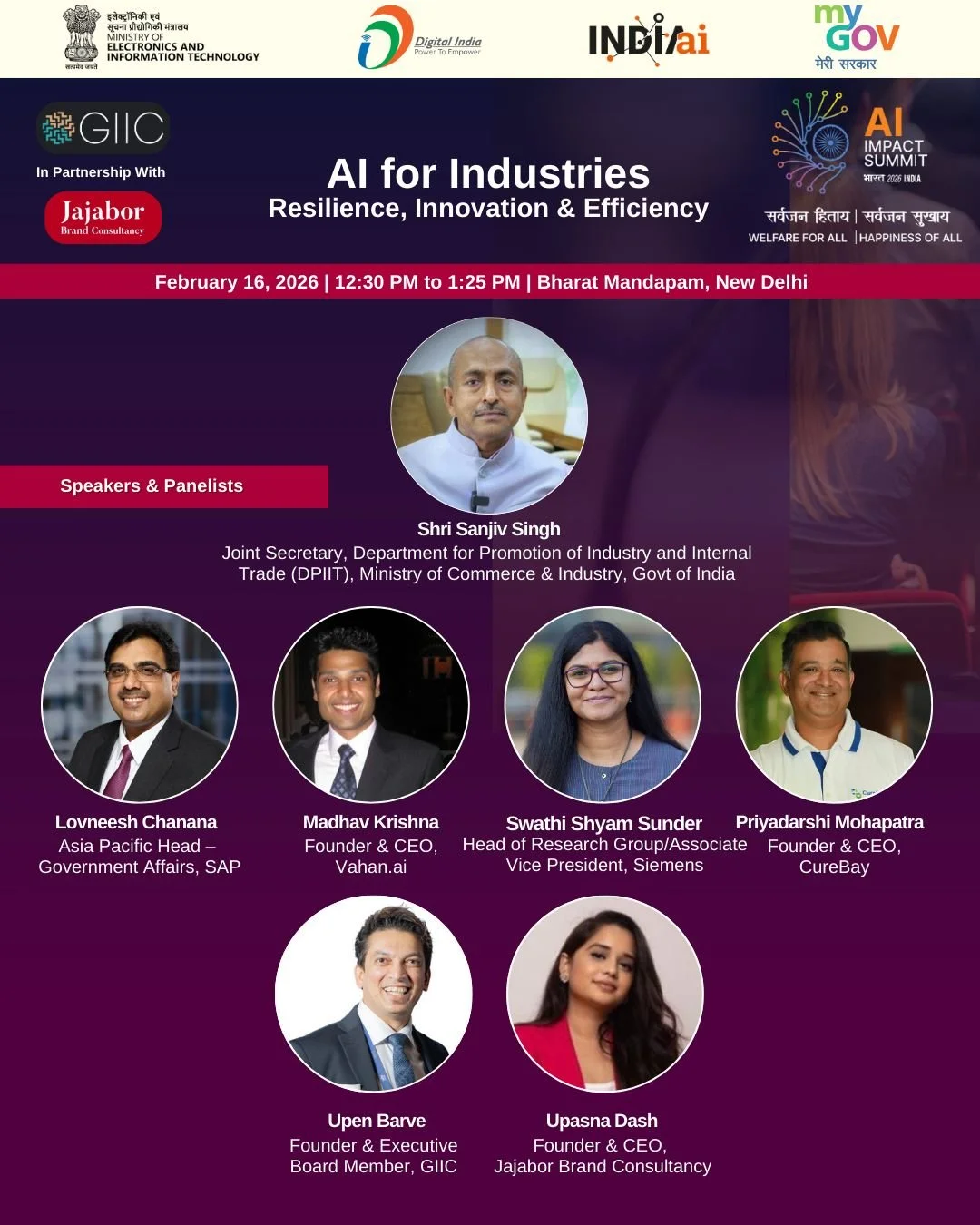
There is a number from the India AI Impact Summit 2026 that deserves to sit with anyone thinking seriously about industrial AI. It comes from a recent SAP and Oxford Economics survey, shared during a session on "AI for Industries: Resilience, Innovation and Efficiency," convened by the German Indian Innovation Corridor.
9%
That is the proportion of organisations that describe their approach to AI as holistic. Not 9% adoption. Adoption is widespread and accelerating. 23% of all business processes in Indian organisations are already AI-supported, and the expectation is that figure will reach 41% within two years. 93% of CXOs and CEOs surveyed believe they will see positive returns on their AI investments within one to three years.
The confidence is abundant. The architecture is not.
This gap, between executive conviction and operational capability, was the recurring theme of a session that brought together SAP, Siemens, Curebay, Vahan AI, and the German Indian Innovation Corridor at Bharat Mandapam in New Delhi. Each panellist approached it from a different sector and a different vantage point. The diagnosis was remarkably consistent.
The Pilot Trap
Clas Neuman of SAP framed the challenge through a distinction that the broader AI conversation has been slow to absorb: the difference between enterprise AI and consumer AI. Consumer AI, he suggested, is the light bulb, visible, immediate, illuminating. Enterprise AI is the power plant, the infrastructure that makes the illumination possible. The analogy is useful because it clarifies why consumer AI adoption feels effortless while enterprise AI adoption stalls. A light bulb requires a socket. A power plant requires architecture.
The survey data supports this. 72% of respondents said they feel they are still not data-ready for AI. The soil, to use Neuman's metaphor, remains rocky. And the experience from organisations that have moved beyond pilots suggests something counterintuitive: the returns on AI investment are non-linear. Pilots can be underwhelming. The value compounds later, often exponentially, but only if the foundational architecture supports that compounding.
This non-linearity is precisely what makes the pilot-to-production transition so difficult for organisations accustomed to linear investment logic. A pilot that delivers modest results gets judged on those modest results. The exponential potential that would emerge from embedding AI horizontally across business processes, rather than deploying it vertically within isolated functions, remains invisible at the pilot stage. And so the pilot stays a pilot.
Neuman proposed an IMPACT framework for scaling: Infrastructure and interoperability, Measurable outcomes, Policy and guardrails, AI as a horizontal layer, technical Centricity, and Talent. The framework is sound. What makes it difficult to execute is that most organisations are structured vertically. Departments own budgets, define problems, and evaluate solutions within their boundaries. Embedding AI as a horizontal layer requires crossing those boundaries, which is an organisational design challenge before it is a technology challenge.
The Production Gap
The Siemens representative reinforced this from the manufacturing perspective, noting that while AI has been democratised sufficiently to produce impressive showcases and prototypes, the barrier from proof-of-concept to production remains significant. Robustness and reliability in operational environments demand something different from what makes a demonstration compelling.
This observation carries particular weight coming from a company with deep manufacturing heritage. The factory floor is unforgiving. A prototype that works in controlled conditions and fails under production load is worse than no AI at all, because it erodes the trust that any subsequent deployment will need to earn. The Siemens perspective highlighted that industrial foundation models, models built to understand engineering drawings, schematics, simulation data, and time-series information from IoT sensors, represent a research frontier distinct from the language models that dominate public conversation about AI.
The session also surfaced a point about workforce transformation that is often discussed in abstract terms but rarely with the specificity it deserves. The Siemens representative described the shift happening on factory floors: humans are no longer the only active workers. They operate alongside collaborative robots, autonomous agents, and intelligent systems. This requires a mindset shift in how people interface with their working environment. The framing was deliberate: this is an opportunity, not a threat. But the opportunity requires investment in vocational education, reskilling, and what was described as moving from being AI-ready to becoming AI-native.
The distinction matters. AI-ready implies preparation for something that will arrive. AI-native implies that AI is already part of how the organisation thinks, operates, and evolves. Most industrial organisations remain in the ready phase, and the distance to native is architectural.
Where Trust Is the Product
Two panellists presented use cases that demonstrated what thoughtful AI integration looks like when the stakes are high and the populations served are complex.
Priyadarshi Mohapatra of Curebay described a healthcare deployment serving rural India, where a billion people lack access to adequate medical infrastructure. Most primary healthcare centres outside the top eight cities are understaffed or unstaffed. The challenge was to reach populations who cannot access doctors and who, when they do seek care, typically present with conditions that are already acute or chronic because economic pressures force them to delay.
Curebay's approach is hybrid. AI performs screening and risk stratification, using photograph-based analysis for conditions like early-stage oral cancer among betel nut users. But the system is designed to connect patients to physical healthcare infrastructure, staffed by qualified doctors, rather than to replace clinical judgement. The AI screens. The human decides. The loop closes in the physical world.
Mohapatra summarised his approach through four principles: trust, transparency, translation, and texture. The framing is instructive because it places the human experience of the technology ahead of the technology itself. A screening tool that creates fear rather than enabling informed action will fail regardless of its accuracy. The design challenge is behavioural and communicative before it is technical.
Madhav Krishna of Vahan AI presented a complementary case from the blue-collar workforce. 80% of India's labour force is blue-collar, and the hiring ecosystem is profoundly fragmented, operating through hundreds of thousands of local recruitment agencies where trust is mediated through personal networks. Vahan's AI recruiter works alongside 3,000 human recruiters across more than 900 cities. The AI handles initial screening, matching, and FAQ responses in multiple Indian languages. When candidates show signs of disengagement, the human recruiter re-enters the process.
The productivity gain is significant: a human recruiter who placed one person per day can place five using the AI system, with a target of fifty within two to five years. But the more important insight is structural. The AI does not attempt to replace the trust that local recruiters hold within their communities. It augments their capacity while preserving the relational infrastructure that makes hiring work in informal economies.
Both cases share an architectural principle that the session's broader discussion kept circling back to: AI that works in complex, high-stakes, trust-dependent environments must be designed as a layer within existing human systems, earning autonomy progressively rather than claiming it at deployment.
The Cross-Border Dimension
The session was convened under the German Indian Innovation Corridor, and the cross-border framing added a dimension that purely domestic AI conversations often miss. Upen Barve of GIIC described the corridor as bundling multiple innovation pathways into a single infrastructure: innovation scouting, deep tech hubs, think tanks, and landing pads connecting the European and Indian ecosystems.
The complementarity is genuine. Germany brings manufacturing depth, enterprise infrastructure, and regulatory maturity. India brings implementation speed, digital scale, and a young working population of over 900 million people between 18 and 60. The EU AI Act and India's DPDP Act create parallel governance frameworks that, while different in specifics, share a commitment to responsible deployment.
The announcement of a Democratic Alliance on AI framework, launched during the summit week, signals that this regulatory convergence is becoming intentional rather than coincidental. For organisations operating across both ecosystems, this matters. The ability to build AI systems that satisfy European governance requirements while deploying at Indian scale is a specific and valuable capability, one that requires architectural thinking from the outset rather than compliance retrofitting after the fact.
Madhav Krishna of Vahan AI raised a point that deserves attention in this context: 97% of the Internet is in English, and most Indian languages have minimal digital footprint. Building AI that serves Indian populations in their own languages is a data challenge of enormous scale, and it is also an opportunity. The organisations and ecosystems that solve for multilingual AI in India will have built capabilities transferable to any multilingual, multi-market context globally.
courtesy: GIIC
Where We Stand, and What We Have Been Building
At Mitochondria, the session on AI for industries reinforced what we encounter in every client conversation. The enthusiasm is real. The pilot results are often promising. And the architecture to move from pilot to production is almost always the missing layer.
We are a young company, and our team brings deep experience across operations, behavioural science, and enterprise AI. The patterns this panel described, the data readiness gap, the non-linear returns, the need for horizontal integration, the centrality of trust, are patterns we have built our methodology around. Hearing them articulated by SAP, Siemens, and practitioners building for India's most underserved populations confirmed that our approach addresses the structural barriers the market is now identifying.
Our work in manufacturing illustrates this concretely.
In a recent engagement with a manufacturing company in India, the discovery process revealed a pattern that would be familiar to any industrial organisation: product evaluation and costing workflows that depended entirely on senior engineering expertise, with no structured capture of how decisions were made. Junior engineers took four to five days on evaluation tasks that senior engineers completed in one to two, because the knowledge that made the difference, which questions to ask, which parameters to check, which material and process combinations to consider, existed only in the experience of individuals. Documents arrived in fragmented formats. Information was assembled manually. When a senior engineer left or was unavailable, the organisation's evaluation capability degraded immediately.
The solution architecture we designed, ATP for Manufacturing, addresses this through a workflow-first approach. The system begins by ingesting and structuring incoming documents: technical descriptions, part lists, material specifications, and industry standards. It presents the engineer with an organised view of everything extractable, replacing hours of manual document assembly with minutes of structured output. From there, it guides the engineer through evaluation decisions conversationally: process routing, material confirmation, tolerance classification, and feasibility flags. Every answer is captured as a structured decision trace.
The engineer experiences a faster, more organised evaluation process. The organisation gains something more significant: a growing body of structured decision intelligence that compounds with every engagement. The knowledge that previously existed only in the heads of senior engineers begins to exist as institutional infrastructure. Junior engineers work faster because the system provides the scaffolding that experience normally provides. Senior engineers work faster because they spend less time on assembly and more on pure decision-making. And the organisation becomes more resilient because its evaluation capability is no longer dependent on the availability of specific individuals.
This is what horizontal AI integration looks like in practice. The system connects to existing infrastructure via API, with no data stored on our side and encrypted transit only. Deployment is phased, beginning with document structuring and intake organisation, progressing to guided evaluation, and advancing to cost sheet assembly as the system demonstrates reliability at each stage. Trust is earned progressively. Autonomy expands only as performance warrants it.
The IMPACT framework that Neuman of SAP proposed, infrastructure, measurable outcomes, policy, horizontal AI, technical centricity, and talent, describes what needs to happen. ATP for Manufacturing is how it happens within the specific operational reality of a manufacturing company, where evaluation quality and speed directly determine commercial competitiveness.
The same architectural principles apply across our sectoral ATP frameworks. Whether the domain is manufacturing, financial services, agriculture, or healthcare, the pattern is consistent: map the actual workflow, not the documented one. Build intelligence that earns trust through demonstrated reliability. Capture institutional knowledge as a byproduct of daily operations. And never assume that a successful pilot means the architecture for production is in place.
We attended this session at the AI Impact Summit because industrial AI is where the most consequential work is happening, and because the conversations between European and Indian ecosystems are shaping how that work will scale across borders. We also attended because we have something specific to contribute: a methodology built for the 91% of organisations that have enthusiasm and pilots but lack the architecture to make AI operational.
From Adoption to Integration
The session concluded with a call from Srinivasan Ravindran, who has spent more than a decade building India's startup ecosystems, for a transition from AI adoption to AI integration. The distinction captures precisely what the preceding discussion had surfaced. Adoption is the acquisition of capability. Integration is embedding intelligence into how an organisation actually functions.
The countries and organisations that will lead in the next decade, as Ravindran noted, are those that embed AI into manufacturing, healthcare, energy, and logistics as operational infrastructure. India brings speed, digital infrastructure at scale, and engineering talent. Europe brings industrial depth, regulatory frameworks that create trust, and capital that thinks long-term. The German Indian Innovation Corridor's 2026 agenda, focused on manufacturing, mobility, aerospace, defence, and health, reflects this convergence.
The 9% figure is a challenge. It is also, for those willing to do the architectural work, an opportunity of extraordinary scale. 91% of organisations have the confidence and the ambition. What they need is the architecture to match.
—
Mitochondria builds ATP — agentic AI for operations. It learns your workflows, earns autonomy in stages, and runs with governance built in. Your data stays yours. Based in Amsterdam and Pune, working with organisations across Europe and India.