
From Principles to Systems in Agricultural AI
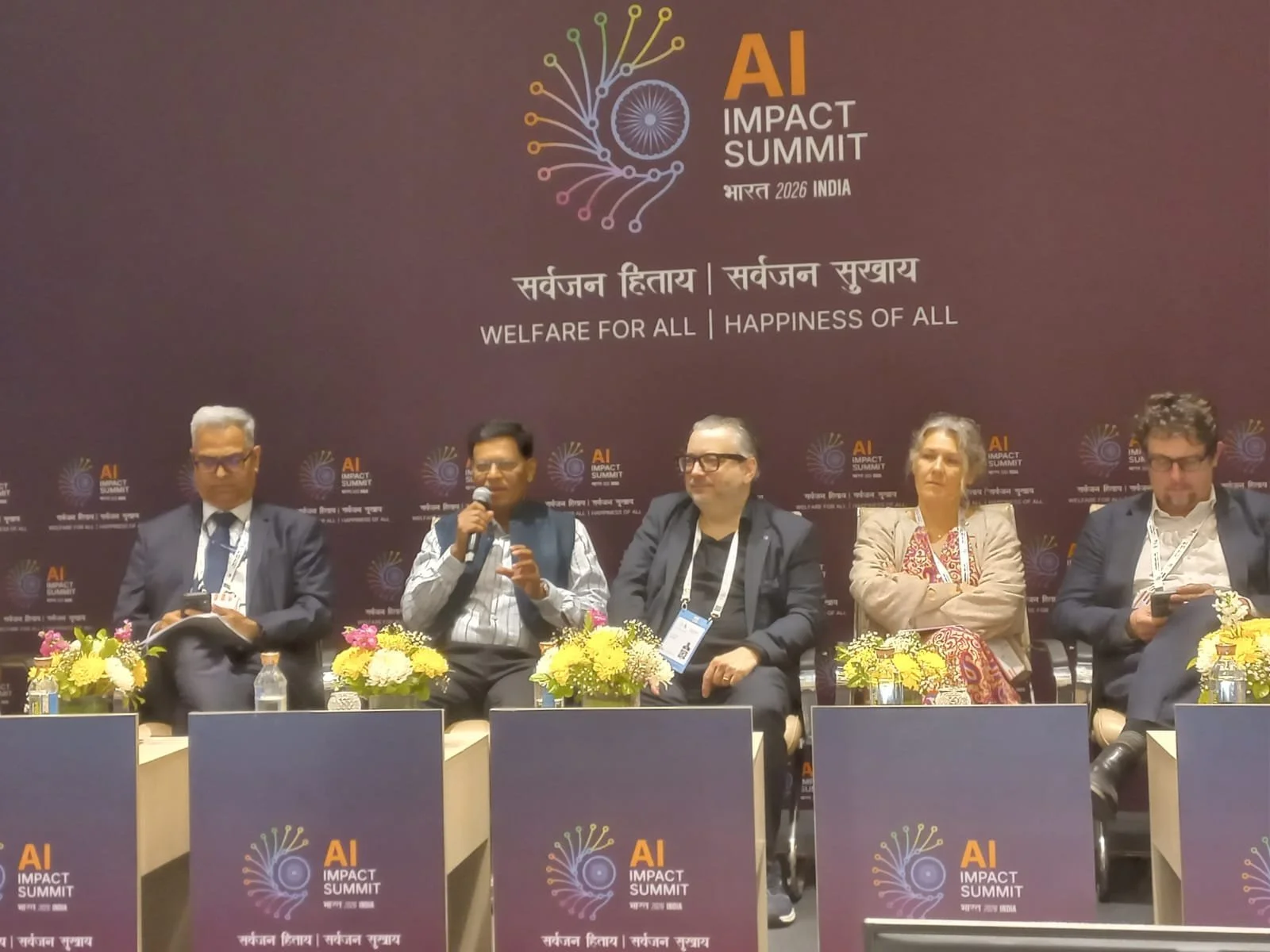
Image Courtesy: BAIF Facebook
There is a particular moment in the maturation of any technology where the community around it reaches moral consensus before it reaches operational capability. The language becomes sophisticated. The frameworks become principled. The shared commitments become genuine. And yet the implementations on the ground remain stubbornly incremental, solving individual problems with individual tools while the systemic challenge waits.
Agricultural AI has arrived at this moment.
At the AI Impact Summit in Delhi this February, a roundtable on "AI for Smart and Resilient Agriculture: From Research to Solutions," chaired by Dr. Thierry Caquet of INRAE France, brought together representatives from the FAO, INRAE, BAIF Development Research Foundation, and several European research and innovation organisations. The conversation was substantive, experienced, and grounded in real field knowledge. It surfaced genuine insights about what farmers need, what data governance demands, and what responsible deployment looks like. It also revealed, perhaps unintentionally, the distance between where the thinking has reached and where the building remains.
The Principles Are No Longer in Dispute
The most striking aspect of the discussion was the depth of agreement. Not performed agreement, not diplomatic consensus, but the kind of alignment that emerges when practitioners from different continents, working in different institutional contexts, arrive independently at the same conclusions.
AI must be inclusive by design: in data, in governance, in who gets a seat at the table. This was the operational starting point for everyone in the room. The FAO's Digital Agriculture AI Roadmap, launched in December 2024, embeds this principle structurally. INRAE's data policy of "open as possible, closed as necessary" operationalises it at the institutional level. BAIF's decades of work with four million farming families annually ground it in the reality of reaching communities that development programmes routinely overlook.
Data sovereignty has become a first-order concern. The volume of data generated through agricultural AI, from animal genomics to soil monitoring to crop yield optimisation, creates value. The question of who captures that value is no longer theoretical. Dr Bharat Kakade, President and Managing Trustee of BAIF Development Research Foundation, was direct: the information generated must be used for the farmers from whom the data comes. This is an ethical architecture point, and the distinction between compliance and architecture matters enormously for how systems get built.
Co-design with farmers is moving from methodology to conviction. INRAE's emphasis on embedding farmer experience in problem definition reflects a maturation in how the research community understands the relationship between expertise and context. A farmer's knowledge of their own land, microclimate, livestock behaviour, and market constraints is foundational data that no satellite image or sensor network can replace.
And perhaps most compellingly, Henri Verdier of Foundation Inria invoked Ivan Illich: "The simple, poor, transparent tool is a noble servant. The elaborate, complex, secret tool is an arrogant master." This is a design specification. Transparency, simplicity, and accessibility are constraints within which the system must be designed to work.
These are serious commitments from serious institutions. The conscience of agricultural AI is developing well.
The Architecture Has Not Followed
When the conversation turned to implementations, to what is actually operating in fields and on farms, the examples were revealing in their specificity and their isolation. AI-enabled neck collars from Areete Solutions for livestock monitoring: heat detection, nutrition management, health tracking. A collaboration between Agriculture Development Trust, Baramati, Microsoft, and Oxford University that enhances sugarcane productivity by 25 to 30 percent. PlantNet, a remarkable open-source application that recognises 70 percent of the world's plant species and can identify diseases. Voice AI prototypes are designed to bypass the literacy and interface barriers that make mobile applications impractical for many rural users.
Each of these is valuable. Some are genuinely impressive. And they remain individual tools addressing individual problems within individual domains.
Agricultural AI has produced a growing catalogue of such tools. Soil monitoring exists. Livestock health tracking exists. Crop advisory services exist. Market price information exists. Weather prediction models exist. Pest detection exists. What does not yet exist, at any meaningful scale, is the intelligence layer that connects these domains into an integrated operational reality.
Consider what Dr Kakade described as the actual condition of Indian smallholder farming. A farmer manages crops, livestock, and increasingly renewable energy generation within the same small parcel of land. The interactions between these domains are the farming system. Crop residues feed livestock. Livestock manure feeds the soil. Solar installations share space with cultivation. Water allocation serves multiple competing needs simultaneously. Market timing for crop sales, livestock products, and energy surplus requires coordinated decision-making across domains that most advisory tools treat as separate concerns.
This is mixed farming, and India, as Dr Kakade noted, has taught it to the world. The AI tools being developed for agriculture have largely inherited the siloed thinking of industrial agriculture, where crop management, livestock management, and energy management are separate professional disciplines with separate data systems and separate advisory channels.
A farmer who uses an AI tool for soil nutrition optimisation, another for livestock heat detection, and another for pest identification is managing three separate information relationships. None of them are aware of the others. None of them can reason about the interactions between domains. None of them can help with the integrated decisions that actually determine farm-level outcomes.
The Most Ambitious Concept Remains in Demonstration
The most architecturally sophisticated idea raised during the session was INRAE's work on digital twins of farms. A digital twin would model the full operational reality of a farm as an integrated system, allowing a farmer to anticipate the consequences of changes before implementing them. It is precisely the kind of systemic thinking that the tool-by-tool approach lacks.
It is also, by the speakers' own account, at the very beginning of its journey. The Twin Farms project is building nine demonstration sites in France. The science, as Carole Caranta of INRAE acknowledged, represents "a very big challenge."
The timeline matters. The 500 million smallholders that the panel repeatedly identified as the population that most needs agricultural AI are making decisions now, this season, about soil inputs, water allocation, livestock management, and market timing. They navigate the same fragmented information environment they have always navigated, now with the addition of a few isolated AI tools that address parts of their reality without connecting them.
What Integration Actually Requires
Moving from tools to systems in agricultural AI demands operational architecture: design thinking that begins with the farmer's actual workflow and builds intelligence around it.
In a mixed farming context, work happens across domains simultaneously. Decisions in one area cascade through others. Information from multiple sources needs to be synthesised into actionable guidance, taking into account the specific conditions of a specific farm, the seasonal rhythms of a specific region, and the financial constraints of a specific household.
The integration layer that agricultural AI needs would maintain awareness across domains, understanding that a decision about crop rotation has implications for livestock nutrition plans and soil health trajectories. It would learn the specific conditions of a particular farm: actual soil composition, water availability, microclimate patterns, and market access constraints. It would earn the farmer's trust progressively, beginning with advisory functions where the farmer retains all decision authority and advancing toward greater autonomy only as the system demonstrates reliable judgement in that specific context. And it would generate structured information as a byproduct of its operation, creating over time an institutional knowledge base that makes the farm more resilient and more legible to the farmer, to financial institutions, to supply chain partners, and to policymakers.
The Ground Truth Beneath the Ground Truth
Olivier Lépine of BradTechnology made a point that deserves more attention than it received. He argued for "the ground truth": the insistence that AI predictions are only as good as the data that feeds them, and that this data must be accurate, local, and live. He acknowledged that the work of building sensor infrastructure is "not very glamorous" but insisted it was foundational.
He is right, and the point extends further. The ground truth of agricultural AI includes the farmer's knowledge of which corner of the field floods first, which livestock breed performs best in local conditions, which market buyer pays reliably and which does not. This tacit operational knowledge is the most valuable data source in any farming system, and it is precisely the data that most AI tools are not designed to capture, structure, or learn from.
Building systems that can engage with this kind of knowledge, that can ask the right questions, interpret contextual responses, and integrate experiential insight with sensor data and satellite imagery, is the architectural frontier of agricultural AI. It is also the frontier where the principles the panel articulated so well would become an operational reality.
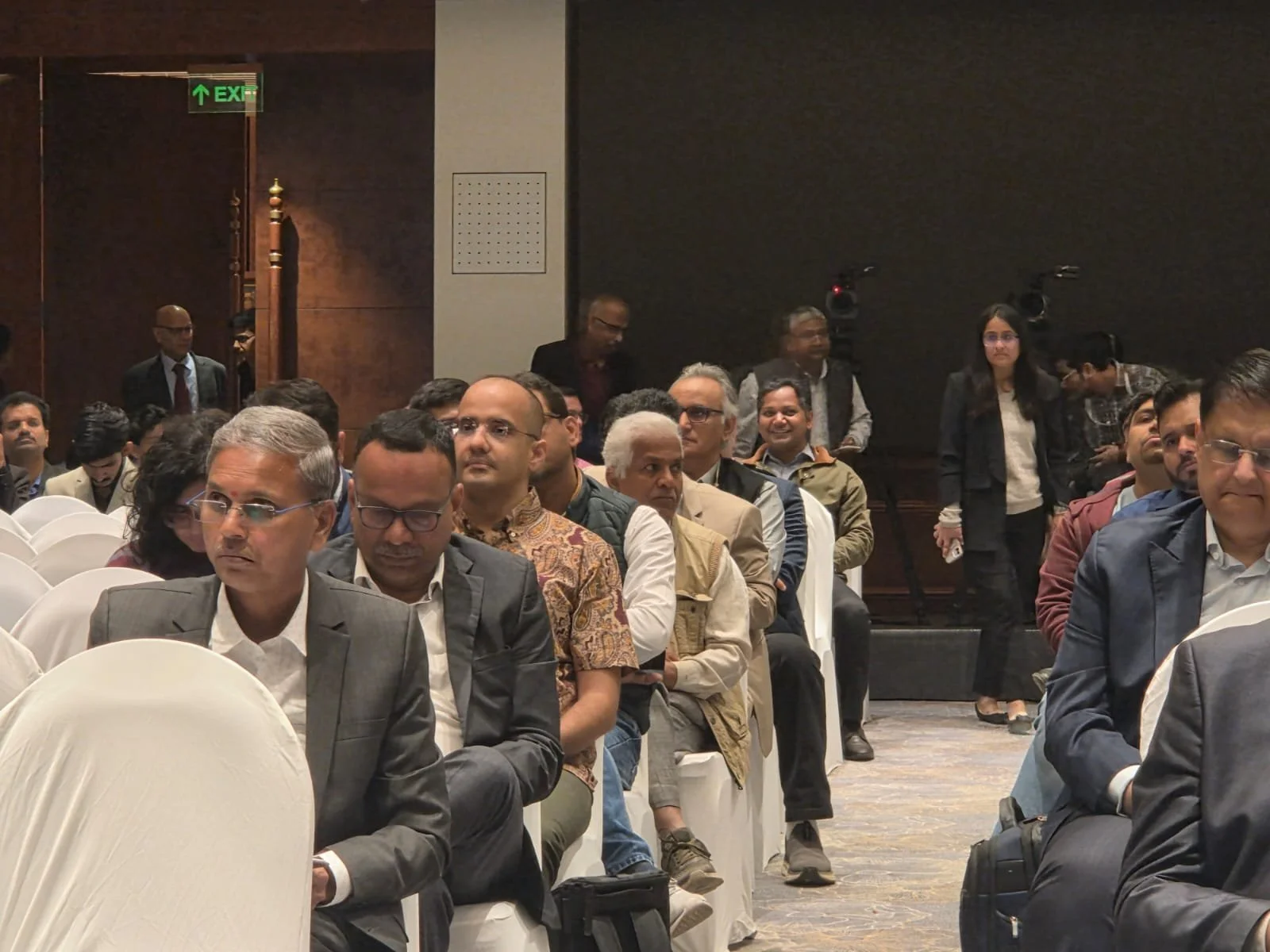
Image Courtesy: BAIF Facebook / Nikita & Sushrut (co-founders, Mitochondria) amongst the audience
Where We Stand, and What We Have Been Building
At Mitochondria, the AI Impact Summit in Delhi reinforced convictions we have been developing through practice. We are a young company, and our team brings deep experience across operations, behavioural science, and enterprise AI. The principles the panel articulated, governance-first design, progressive trust, data sovereignty by architecture, workflow-first deployment, are principles we operationalise in every engagement. Hearing them echoed by the FAO, INRAE, and BAIF was a validation of direction, and a signal that the broader ecosystem is arriving at conclusions we have been building on since our founding.
Our work in agriculture illustrates how we approach sectoral complexity.
In a recent engagement with an agricultural services company in India that serves over 100,000 registered farmers across multiple states, the discovery process surfaced precisely the gaps this panel discussion described. Farmers were engaging once and then going dormant. Support channels were fragmented, with no visibility into what farmers were asking or whether their concerns were being resolved. Ground teams relied on unstructured, emotional communication rather than consistent, fact-based guidance. The information environment was rich in data but poor in intelligence. Farmer profiles, transaction histories, crop data, and geographic information all existed in backend systems. They had never been connected into a coherent conversational layer that could meet farmers where they are.
The solution architecture we designed reflects what we heard validated at the summit. ATP for Agriculture begins with what we call Stimuli: a comprehensive mapping of the operational reality, not the documented version, but the actual workflows, communication patterns, seasonal rhythms, and farmer behaviours that define how the organisation functions. This mapping phase is where most AI deployments cut corners, and where most failures originate. Understanding that a farmer in Bihar harvests in April while a farmer in Maharashtra harvests in March, that loan applications cluster in specific weeks, that price expectations at the point of sale are shaped by informal market intelligence rather than formal data: these are the contextual realities that determine whether an AI system earns trust or becomes another ignored channel.
From this foundation, the designed system provides multilingual conversational AI for farmer support, meeting farmers on WhatsApp and through voice in their preferred language. Every interaction would be captured, structured, and made visible: issue types, resolution paths, escalation triggers, satisfaction signals. The system connects to existing backend infrastructure via API, with no data stored on our side and encrypted transit only. Deployment is phased, beginning with a focused pilot and scaling as the system demonstrates reliability. As the system learns the specific patterns of farmer behaviour and regional variation, it progresses from reactive support toward proactive engagement: identifying dormant farmers, understanding their reasons for disengagement, and re-establishing relationships with contextually relevant, timely outreach.
Trust is earned progressively: the system begins in an advisory capacity, with human-in-the-loop routing for complex queries, and autonomy expands only as performance warrants it. Data sovereignty is architectural: transient processing, no storage, full compliance with DPDP and GDPR frameworks. The farmer's tacit knowledge, captured through conversational interactions over time, becomes structured information that improves the system's intelligence with every exchange.
This is the rigour we bring to agricultural AI. The sector-specific ATP framework is designed to be tailored to each use case, from warehousing and financial services to crop advisory and supply chain coordination, with the underlying architecture consistent across engagements: workflow-first mapping, progressive autonomy, and structured information capture that compounds over time. Each conversation with a potential client deepens our understanding of the specific patterns, constraints, and opportunities that define agricultural operations. That learning, even at the pre-deployment stage, is itself valuable, and it compounds.
We attended the AI Impact Summit because agricultural AI matters and because the conversations happening there matter. We also attended because we have something concrete to contribute: a methodology that takes the sector's complexity seriously, a governance-first approach that the sector's own leaders are now calling for, and the operational humility to begin with understanding before building.
From Green Revolution to Green Intelligence
The session concluded with a reference to a framing from ENAM AI, the Indian Ministry of Education's initiative for responsible agricultural AI research: the transition "from green revolution to green intelligence." It is an elegant phrase. The green revolution transformed agricultural productivity through standardised inputs applied at scale. Green intelligence would transform it through context-sensitive, locally adapted, systemically integrated decision support.
The distance between those two concepts is the distance between a tool and a system, between a point solution and an operational architecture, between principles articulated at a summit and principles embedded in technology that a farmer in Maharashtra or Madhya Pradesh or Senegal actually uses to make better decisions for their land, their livestock, and their family.
Agricultural AI has built a strong conscience. The work now is to build the architecture that deserves it.
—
Mitochondria builds ATP — agentic AI for operations. It learns your workflows, earns autonomy in stages, and runs with governance built in. Your data stays yours. Based in Amsterdam and Pune, working with organisations across Europe and India.