
Enterprise AI in the EU-India Corridor
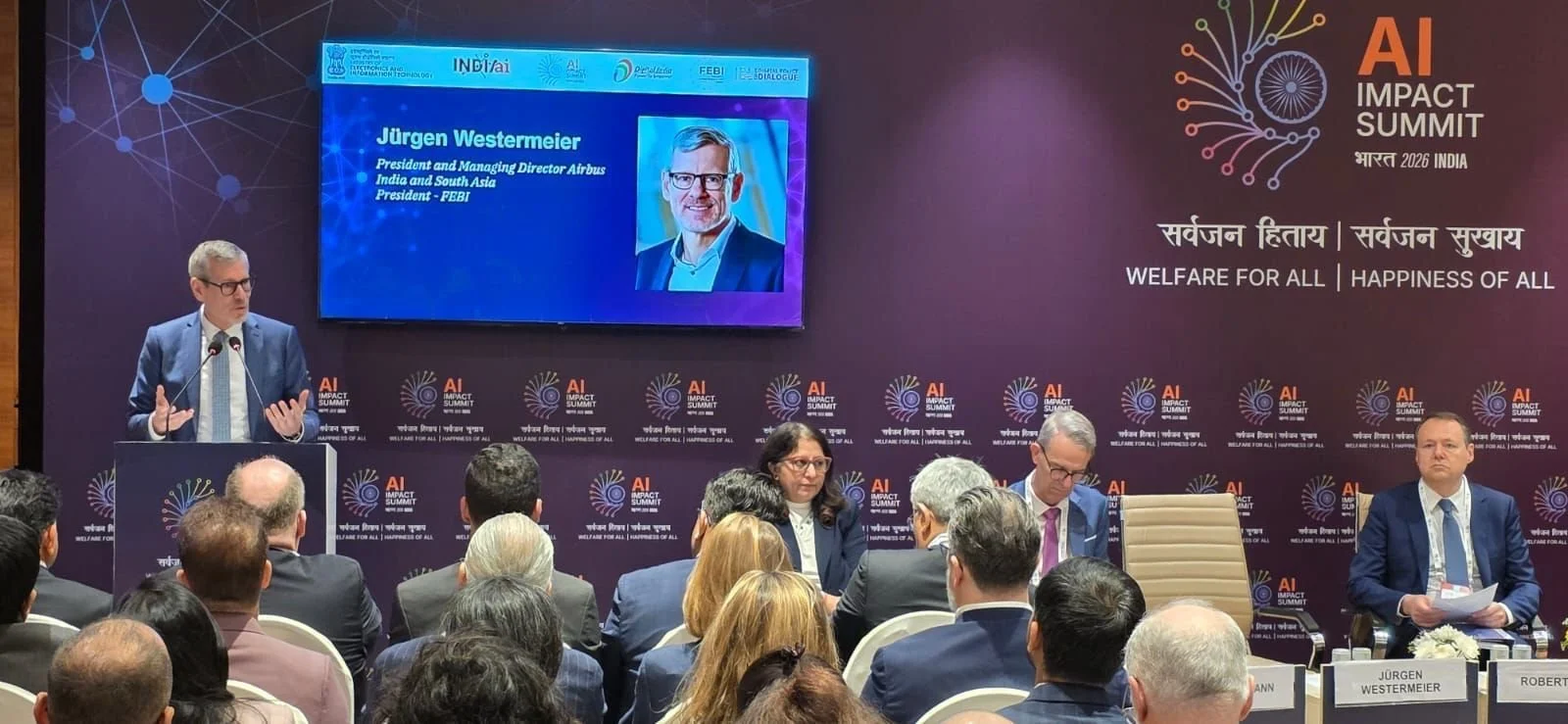
courtesy: FEBI (LinkedIn)
Two weeks before the India AI Impact Summit 2026, the EU and India concluded negotiations on a free trade agreement. The timing was not coincidental. The roundtable on "Opportunities for EU-India Collaboration for Twin Transition," organised by the Federation of European Business in India at Bharat Mandapam, positioned AI and sustainability as the operational substance of that agreement. The question was not whether the EU and India would deepen economic ties, but how enterprise AI would function across the regulatory, technical, and cultural landscape that connects them.
The panel assembled by FEBI reflected the scale of the opportunity: Roberto Viola, Director General for Communications Networks, Content and Technology at the EU Commission; Jürgen Westermeier, President of FEBI and President and Managing Director of Airbus for India and South Asia; Olivier Blum, Global CEO of Schneider Electric; Clas Neumann, Global Head of SAP Labs Network; Dr. Magnus Ewerbring, Head of Advanced Technology and CTO APAC at Ericsson Group; and Christian Wickert, Head of Global Digital Policy at Merck Life Science. The moderating and wrap-up was handled by Sonia Prashar, FEBI Secretary General, and Dr. Lovneesh Chanana.
The twin transition, as discussed across this roundtable, is not a phrase. It is an industrial strategy. Digital transformation and sustainability are not parallel workstreams. They are architecturally interdependent. AI that is not sustainable is a liability. Sustainability that is not digitally measured, analysed, and optimised is an aspiration. The companies and countries that understand this integration will define the next decade of industrial competitiveness.
Digital Interoperability as Foundation
Roberto Viola described the EU-India digital cooperation roadmap in concrete operational terms. The EU Commission has signed an agreement with India to mutually recognise e-signatures, a foundational step toward full digital interoperability. The European business wallet, which brings together company identity, signatures, and timestamping into a single trusted digital layer, includes a specific provision for mutual recognition with Indian digital infrastructure.
The interoperability testing between India's Aadhaar system and the European digital identity wallet is already underway and, according to Viola, showing positive results. The European citizens’ wallet, expected to be operational for every EU citizen this year, will eventually work seamlessly with its Indian counterparts. The ambition is that any digitally generated trust document from an Indian company or a European company can be mutually recognised, simplifying both business-to-government and business-to-business interactions across the corridor.
Viola framed the cooperation in three horizons. Short-term: digital interoperability through mutual recognition of signatures, identities, and trust documents. Medium-term: AI cooperation across healthcare, industry, aerospace, material science, and pharma, built on shared compute capacity and cooperative research. Long-term: a seamless knowledge area between the EU and India, with shared aims around open models, open supercomputing, and cooperative research for both digital advancement and sustainability.
India is the only country with which the EU maintains an active Trade and Technology Council. The infrastructure for deep collaboration is not aspirational. It is being built.
AI Needs Energy. Energy Needs Intelligence.
Olivier Blum of Schneider Electric delivered the most structurally important argument of the session. The relationship between AI and energy is not one-directional. AI requires enormous and growing amounts of energy. Data centre rack densities have moved from 10 to 40 kilowatts a few years ago to 150 kilowatts today for AI workloads, with designs targeting 1 megawatt per rack in the coming years. The 800-volt DC electrical infrastructure required to support these densities does not yet exist in production but is being designed, with the first deployments expected in the US within three to five years.
The scale of the energy challenge is substantial. Blum cited projections that US AI data centre energy consumption will, within four years, equal the electricity consumption of the entire African continent. This is not a marginal increase. It is a structural transformation of global energy demand.
But Blum's argument was not pessimistic. Energy needs intelligence as much as AI needs energy. A connected, AI-managed electrical panel in a home can reduce energy consumption by 20 to 30% without the occupant noticing, simply by optimising when and how energy is used. Digitised power systems, managed by AI, can balance supply and demand dynamically across grids, buildings, and industrial facilities. The twin transition is not a trade-off between digital advancement and sustainability. It is the mechanism by which sustainability becomes operationally achievable.
His assessment of India was direct: the country has the largest pool of engineering talent in the world for power and automation, the most intense infrastructure pressure from temperature and population density, and a digital-native ecosystem that accelerates adoption. If you crack the code in India, he argued, you crack it for the planet.
Industrial AI, Not Consumer AI
Clas Neumann of SAP articulated a position that resonated across the panel: the twin transition requires an AI-first approach, not an AI-added approach. Measuring sustainability, analysing operational data for environmental impact, and optimising processes for both efficiency and reduced emissions are tasks that AI must be embedded in from the design stage, not layered on as a reporting function.
SAP's Green Ledger concept captures this: translating sustainability efforts into financial metrics so they can be reported, compared, and optimised with the same rigour as revenue and costs. This requires aligned measurement frameworks between the EU and India, which is precisely the kind of regulatory interoperability that Viola described as a priority.
Neumann also raised the fragmentation challenge. AI regulatory frameworks differ significantly across countries, and not always productively. For companies operating across the EU-India corridor, the need for harmonised or at least interoperable standards is practical, not theoretical. Every regulatory divergence adds compliance cost and slows deployment.
Christian Wickert of Merck Life Science reinforced the industrial AI thesis from the life sciences perspective. Merck's work in bio-convergence, where biology and chemistry converge with data science and AI, is transforming the entire biotech value chain. Their drug discovery model, Tintia, designs molecules computationally. Their digital lab is moving toward full autonomy. Their Syntropy joint venture with Palantir builds a trusted data layer where organisations can share data while controlling IP and cybersecurity. Wickert assessed that 2026 will be the first year AI-driven drugs enter clinical trials, the tangible result of years of industrial AI investment.
The common thread is that consumer-facing AI, the chatbots and general-purpose assistants, is a small fraction of where AI creates economic and environmental value. Industrial AI, embedded in manufacturing, supply chains, drug discovery, energy management, and operational governance, is where the twin transition happens. And industrial AI requires precisely the kind of governed, compliant, trust-first architecture that enterprise buyers demand before procurement.
Trust Is the Precondition
Every panellist converged on trust as the central requirement. Neumann stated it directly: the most sophisticated AI systems are useless if customers do not trust the analysis and results. Trust is not only in the technology. It is between governments, between regulatory systems, between organisations operating across jurisdictions.
Westermeier of Airbus framed the position from the aviation industry's perspective: technology must be human-centric. AI is a responsible and ethical enabler designed to augment human capability. At Airbus, this is operational rather than aspirational. Their smart engineering assistant supports 14,000 engineers globally. The Skywise platform saves the global airline industry over $200 million annually through predictive maintenance. AI is delivering tangible value, but within a framework where human expertise remains central, and governance is embedded in the design.
Ewerbring of Ericsson extended the trust argument to infrastructure reliability. Security, resilience, and robustness are foundational. Without them, trust cannot even begin. But trust extends beyond technical security. It is a judgement made by individual organisations, earned through demonstrated performance, and never compromisable.
Wickert added the ethics dimension: Merck's code of digital ethics requires all AI products and services to comply before deployment. Their digital ethics advisory panel includes civil society, academia, and industry members. Ethics by design, he argued, creates a foundation for trust that is somewhat independent of the regulatory variation across jurisdictions.
The implication for any company building enterprise AI for the EU-India corridor is clear. Trust is not a feature to be marketed. It is an architectural requirement that determines whether procurement conversations begin at all.
How Mitochondria Operates in This Corridor
Mitochondria is based in Amsterdam and Pune, operating across the EU and India. The twin transition corridor that this roundtable described, where digital transformation and sustainability are integrated into a single industrial strategy, governed by interoperable regulatory frameworks and built on trust, is the environment our company was designed for.
The architectural requirements that every panellist articulated map directly to how ATP is built. Governance is structural, not retrofitted. GDPR compliance through our EU registration and DPDP compliance through our Indian operations are not separate compliance exercises. They are built into the same architecture, with transient data processing, no storage on our side, encrypted transit, and audit trails that satisfy both regulatory frameworks simultaneously. For companies operating across the EU-India corridor, this dual compliance is not a theoretical advantage. It is a practical requirement that most AI providers cannot meet because they were not designed for this specific operating environment.
The trust-first approach that the panel described, where enterprise procurement leads with governance questions before evaluating capability, is how every Mitochondria engagement begins. Our Stimuli phase maps the operational reality, identifies compliance requirements, establishes governance frameworks, and defines the boundaries of what the system will do before any AI capability is deployed. This is not caution. It is the architecture that enterprise buyers in both the EU and India require.
The industrial AI thesis, that the consequential value of AI lies in operations rather than consumer interfaces, is the thesis Mitochondria is built on. ATP operates inside manufacturing workflows, financial services compliance processes, agricultural supply chains, and multi-stakeholder coordination environments. These are the contexts where the twin transition plays out: where operational efficiency and sustainability measurement are the same system, where AI is embedded in decision-making rather than advising on it, and where governance is continuous rather than periodic.
Neumann's Green Ledger concept, translating sustainability into financial metrics, requires exactly the kind of structured data layer that ATP creates as a byproduct of operational deployment. When every workflow interaction is captured, structured, and auditable, the measurement infrastructure for sustainability reporting already exists. It does not need to be built separately.
Blum's observation that energy needs intelligence applies at every scale of deployment. Even within individual enterprise operations, the ability to measure, analyse, and optimise resource usage through AI-driven systems is a sustainability outcome that emerges from digital transformation. The twin transition is not two projects. It is one architecture. And that architecture requires the kind of governed, compliant, trust-first AI that Mitochondria builds.
The EU-India corridor is expanding rapidly. The trade agreement, the digital interoperability roadmap, the Trade and Technology Council, and the shared commitment to AI cooperation across healthcare, industry, and sustainability are creating an environment where enterprise AI providers must operate credibly in both regulatory landscapes. Mitochondria was designed for this from founding: Amsterdam and Pune-registered, EU-compliant, operating in India with DPDP-ready architecture, and building agentic AI that meets the governance requirements of both jurisdictions.
The twin transition requires AI that is industrial, governed, trustworthy, and interoperable across the corridor. That is what we build.
—
Mitochondria builds ATP — agentic AI for operations. It learns your workflows, earns autonomy in stages, and runs with governance built in. Your data stays yours. Based in Amsterdam and Pune, working with organisations across Europe and India.