

Insights on Agentic Intelligence, Systems Design & Applied AI
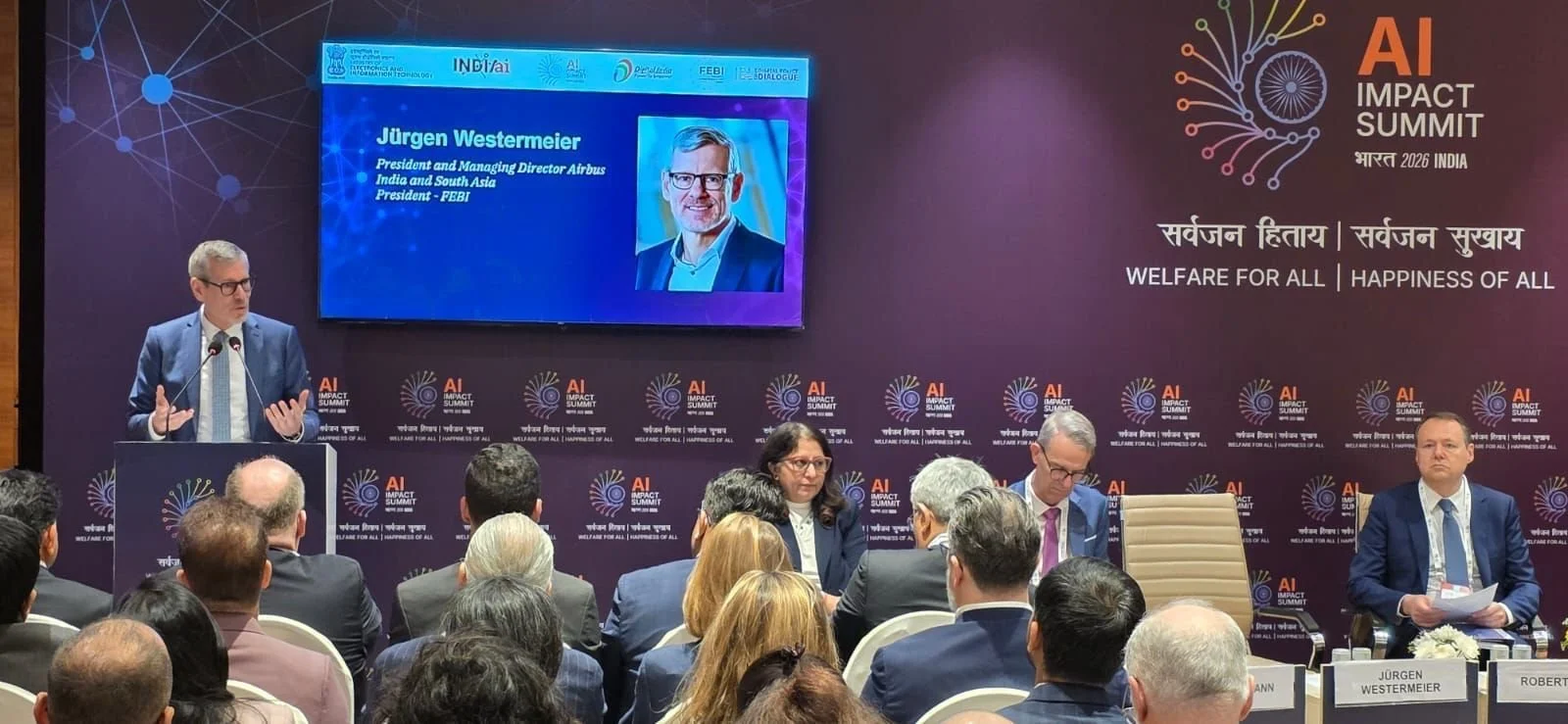
Enterprise AI in the EU-India Corridor
The twin transition is not two parallel initiatives. It is one integrated industrial strategy where digital transformation and sustainability are mutually dependent. At the India AI Impact Summit 2026, a roundtable organised by the Federation of European Business in India brought together the EU Commission, Airbus, Schneider Electric, SAP, Ericsson, and Merck Life Science to examine what this integration requires from AI. The answer was consistent across every panellist: AI embedded in operational design from the outset, governance as architecture rather than afterthought, trust as the precondition for enterprise adoption, and interoperability across the EU-India regulatory landscape. This is the corridor Mitochondria was built for.

Building AI Infrastructure for the Organisations That Need It Most
Agentic AI is designed to undertake comprehensive workflows and exercise judgement within defined boundaries. It does not merely execute predefined tasks according to rigid rules. It navigates complexity, handles exceptions, and makes contextual decisions that previously required human attention. This requires organisational readiness that most organisations lack: data infrastructure, process clarity, technical capability, and leadership prepared for a different relationship between human and artificial intelligence. Organisations that wait until they are ready before deploying AI often wait indefinitely. The work of building data infrastructure, documenting processes, and developing integration capability is not urgent until something demands it. Deployment itself is a forcing function for readiness. We design our deployments to harness this constructively, building readiness through deployment rather than waiting for readiness before deployment begins.

The 20 Percent Problem: Why Legal Process Automation Keeps Hitting a Ceiling
Talk to anyone running legal automation in production, and a familiar number emerges: 20 percent. That's the portion of cases that don't fit the happy path—the exceptions that break the automation and drop matters back into human queues. In high-volume practices like residential conveyancing, that exception rate translates to hundreds of matters requiring manual intervention annually. The ceiling isn't a reflection of chaotic, unpredictable legal work. It's a reflection of systems that can't adapt to variation within predictable domains. Agentic AI changes this equation by introducing what current architectures lack: a real-time feedback loop where every exception becomes training data and every human intervention teaches the system how to expand its competence.

The Compliance Bottleneck No One Talks About: Why Agricultural Supply Chains Are Struggling with Transparency
A Dutch food company sources quinoa from Rajasthan. The European market demands residue-free certification. Somewhere between a farmer's field in western India and a warehouse in Rotterdam, compliance documentation needs to flow seamlessly across languages, formats, time zones, and regulatory frameworks. Right now, that flow runs through Excel sheets. This isn't an edge case—it's the norm. And it explains why agricultural supply chain transparency remains one of the most talked-about yet least-solved problems in global trade. The companies getting this right have stopped treating technology as a reporting layer bolted onto existing processes and started redesigning processes around what agentic AI now makes possible.

Europe's Innovation Gap: Why Agentic AI Might Be the Smartest Catch-Up Strategy
European businesses don't need to invent the next breakthrough technology. They need to deploy what already exists—intelligently and autonomously. Between 2008 and 2023, US GDP grew by 87 percent while the EU managed just 13.5 percent. But the conventional response—that Europe must conjure its own Silicon Valley—misses a more practical path forward. South Korea didn't create the semiconductor. Taiwan didn't invent contract manufacturing. Yet both built world-leading industries by adopting and operationalising technologies developed elsewhere. With agentic AI, Europe's regulatory complexity becomes a use case, not just a burden. Systems that automate compliance at scale turn a cost centre into a competitive moat.