
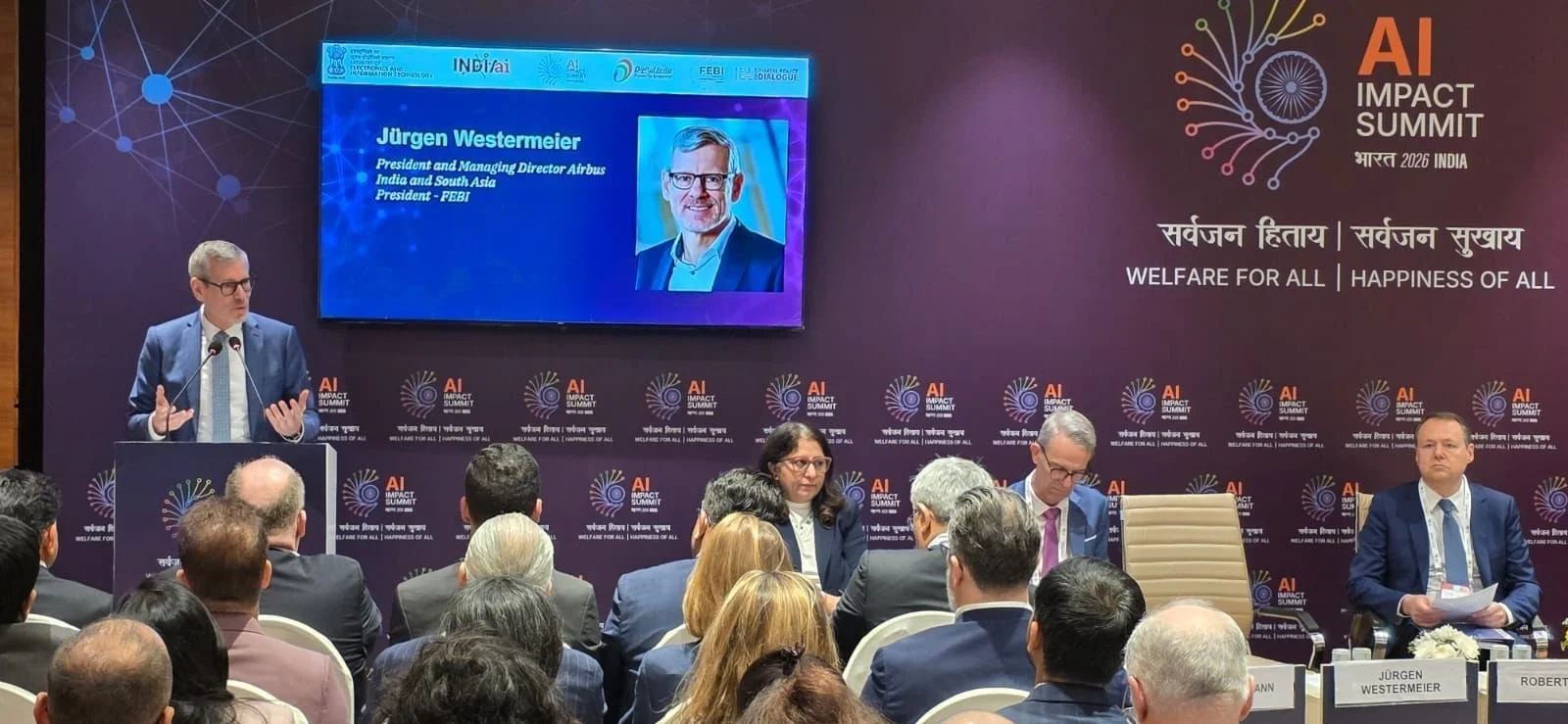
courtesy: FEBI (LinkedIn)
The EU and India concluded negotiations on their free trade agreement on 27 January 2026, the largest either side has agreed. On 11 September, the European Commission sent the text to the Council for approval, with signature targeted for December and entry into force expected in 2027, subject to the European Parliament's consent and India's ratification.
Two weeks after negotiations concluded, the Federation of European Business in India (FEBI) convened a roundtable at the India AI Impact Summit on EU-India collaboration for the twin transition. The panel included Roberto Viola, Director General of DG CONNECT at the European Commission; Jürgen Westermeier, President of FEBI and head of Airbus in India and South Asia; Olivier Blum, CEO of Schneider Electric; Clas Neumann of SAP; Dr Magnus Ewerbring of Ericsson; and Christian Wickert of Merck. Their discussion set out what the agreement means in practice for enterprise AI.
The twin transition is one strategy, not two
Across the panel, digital transformation and sustainability were treated as interdependent. AI that is not sustainable becomes a liability. Sustainability that is not digitally measured, analysed and improved stays an aspiration. Companies that integrate the two will set the pace of industrial competitiveness in both markets.
Digital trust that crosses borders
Viola described the digital cooperation roadmap in concrete terms. The EU and India have agreed to recognise each other's e-signatures. The European business wallet, which combines company identity, signatures and timestamps, includes provision for mutual recognition with Indian digital infrastructure, and interoperability tests between Aadhaar and the European digital identity wallet were, he said, showing positive results. The aim is for a trusted digital document from an Indian or a European company to be recognised on both sides.
He framed the cooperation in three horizons: digital interoperability now; joint AI work in healthcare, industry, aerospace, materials and pharma next; and in time a shared knowledge area for research and sustainability. India is the only country with which the EU runs an active Trade and Technology Council.
AI needs energy; energy needs intelligence
Blum argued the relationship runs both ways. AI workloads are driving data centre rack densities far beyond what conventional facilities were built for, and he cited projections that US AI data centre demand could soon rival the electricity use of the entire African continent. But AI also makes energy systems smarter. A connected, AI-managed home panel can cut consumption by 20 to 30%, he said, without the occupant noticing. His view of India was direct: with the world's largest pool of power and automation engineers and intense infrastructure pressure, solving it in India means solving it for the world.
Industrial AI, built in from the start
Neumann called for an AI-first rather than AI-added approach: measuring and improving environmental impact has to be designed into operations, not bolted on as reporting. SAP's Green Ledger turns sustainability effort into financial metrics, which requires measurement frameworks that align across the EU and India. He also warned that regulatory fragmentation adds cost to every cross-border deployment.
Wickert described how Merck applies AI across the biotech value chain, from computational molecule design to increasingly autonomous labs, and expected 2026 to bring the first AI-designed drugs into clinical trials.
Trust is the precondition
Every panellist returned to trust. Neumann noted that the most sophisticated system is useless if customers do not trust its results. Westermeier described AI at Airbus as human-centric by design, supporting thousands of engineers. Ewerbring placed security, resilience and robustness at the foundation. Wickert described Merck's code of digital ethics, which every AI product must meet before release.
For companies working across the corridor, trust is not a marketing claim. It is an architectural requirement that decides whether procurement conversations begin at all.
What this means for companies trading across the corridor
The agreement will lower tariffs. Evidence requirements will rise. European buyers increasingly need traceable sustainability and due diligence evidence from suppliers, whether for the CSRD, the EU Deforestation Regulation or their own customers. Indian listed companies report under SEBI's BRSR. A supplier that can produce consistent, verifiable evidence for both sets of expectations will find the corridor easier to trade in.
How Mitochondria's agentic AI systems serve the corridor
The approach. Mitochondria works from Amsterdam and Pune, under one architecture that meets GDPR and India's DPDP Act, is ISO/IEC 27001:2022 certified, and aligns with the EU AI Act. Client data stays in client systems, processed in-region or on-premises where required.
What it enables. Indian suppliers can keep compliance evidence current and prepare disclosures for European buyers and regulators, while meeting BRSR at home. European companies can deploy agentic AI for Indian operations with governance their own compliance teams recognise. Each unit is configured to both rulebooks where a workflow crosses them.
The impact. Less friction in cross-border trade, one body of evidence serving both markets, and sustainability measured as part of operations rather than reconstructed for each report.
Read more about sustainability and compliance.
Sources
FEBI roundtable on EU-India collaboration for the twin transition, India AI Impact Summit 2026, as presented
Swarajya, Commission sends India-EU FTA to the Council, September 2026
—
Mitochondria builds agentic AI for evidence-led core operations. Research-led and model-agnostic. ISO/IEC 27001:2022 certified, with controls aligned to the GDPR, UK GDPR, India's DPDP Act and Australia's Privacy Act. Amsterdam and Pune. Request a working session →