
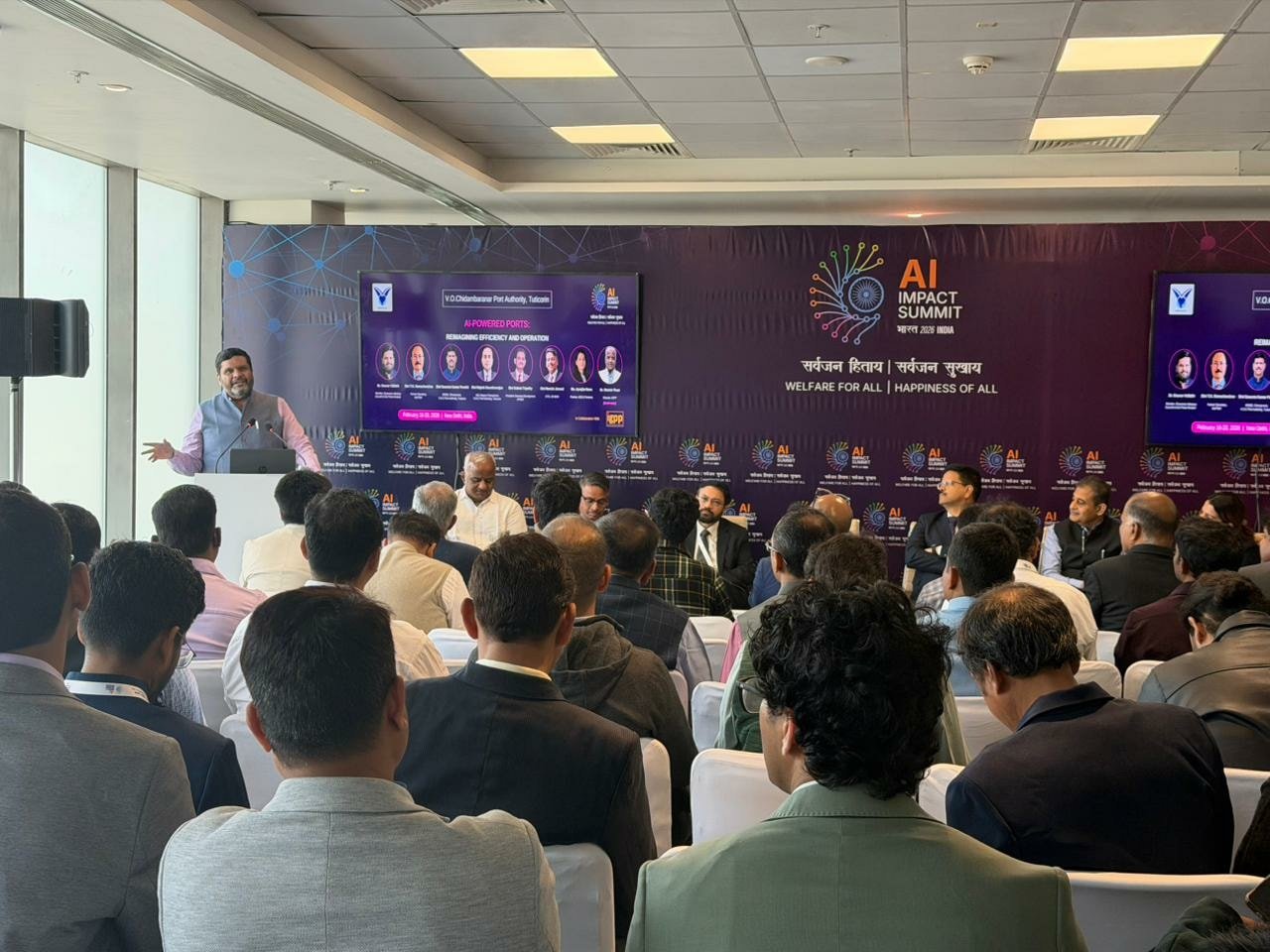
courtesy: Prof. Gourav Vallabh (Facebook)
India's 12 major ports handled a record 915.17 million tonnes of cargo in FY26, up about 7% from the previous year and ahead of the government's target. Jawaharlal Nehru Port Authority ranked 23rd in the world in the 2024 Container Port Performance Index, published by the World Bank and S&P Global, and seven Indian ports now feature in the global top 100. New capacity at Vizhinjam and Vadhavan will add considerably more.
The progress is real. So is the remaining gap. Across the system, berth and yard productivity, dwell times and vessel turnaround still trail the world's best ports by a wide margin. These are not infrastructure deficits. The cranes, berths and yards exist. What is missing is the integration layer that makes them work as one system.
At the India AI Impact Summit 2026, a session on AI-powered ports, organised by V.O. Chidambaranar Port Authority with the Institute for Governance, Policies and Politics, brought together policymakers, port operators, technology leaders and lawyers to examine what AI can and should do for Indian maritime operations. It surfaced a distinction that clarifies the challenge: the difference between a smart port and a thinking port.
Smart ports have technology; thinking ports have judgement
T.K. Ramachandran, former Secretary at the Ministry of Ports, Shipping and Waterways, set out the distinction. Smart ports have technology-led operations, automation, real-time visibility and digital systems managing separate functions. Thinking ports run on decisions: they anticipate rather than react, integrate across systems and learn as they operate.
The shift moves along several lines at once: from automation to judgement, from real-time monitoring to predictive planning, from siloed systems to shared frameworks, and from repetitive processes to adaptive ones. Analytics researchers describe the same ladder in four steps: descriptive (what happened), diagnostic (why), predictive (what will happen) and prescriptive (what to do). Most port systems today sit on the first rung. A thinking port climbs to the fourth.
India's ports have invested heavily in the foundations. Enterprise business systems run at several major ports, and national platforms such as Sagar Setu are in place. The One Nation, One Port initiative, launched in March 2025, is standardising processes across ports. In May 2026, the government introduced a Logistics Port Performance Index to benchmark ports against each other. In Ramachandran's view, these are the prerequisite layers on which AI must be built, not the AI layer itself.
800 documents became 200
Ramachandran shared a detail that shows the scale of the structural work. When One Nation, One Port examined the documents in use across India's major ports, it found more than 800. After removing duplicates and identifying what was essential, the core set came down to around 200. The processes behind them, covering customs, health, port operations and workflows unique to individual ports, were consolidated into roughly 50 to 60 standard processes.
This work must happen before AI becomes useful. Eight hundred documents in different formats across separate systems give AI nothing coherent to learn from. Mapping 200 core documents to 60 standard processes makes prediction and decision support possible. The same holds in every sector: AI deployed on top of unstandardised operations fails, and the structuring work is where much of the value is created.
A port is many organisations at once
Subrat Tripathy of APSEZ described the complexity any port AI must handle. A port is not one organisation. It is a meeting point for shipping lines, agents, transporters, customs, health inspectors, warehouse operators and many others, each with its own systems, data and decisions.
He outlined five areas where AI can help: design and planning, using digital twins for layout and capacity; operations, including dynamic yard logistics and berth allocation; safety and risk; quality and customer service; and benchmarking against the world's best. He described a virtual concierge: one interface through which vessels, agents, and transporters deal with the port, replacing today's fragmented channels.
International practice shows what is possible. The International Maritime Organisation made electronic single windows for ship clearance mandatory for its member states from January 2024, so that information is submitted once and shared among authorities. Singapore coordinates vessel calls across parties rather than through separate decisions. Panellists cited Rotterdam's use of AI to cut ship waiting times. Each depends on the integration layer India is now building.
Tripathy also pointed to the Ever Given's grounding in the Suez Canal in 2021, which held up hundreds of vessels. Ports that run reactively stay exposed to disruption. Ports that anticipate can absorb shocks and keep cargo moving.
Accountability when AI decides
Aprajita Rana of AZB & Partners raised the dimension most industry discussions omit: legal accountability when AI moves from advising to deciding. Port transactions involve many agencies. When a person decides, accountability is clear. When an AI system decides, especially where unusual situations are common, and the consequences can be economic, environmental or safety-related, liability becomes complex.
She identified several gaps. Technology contracts often leave port operators carrying most of the liability for AI-driven outcomes. India does not yet have an AI law that sets out how liability is attributed when autonomous systems cause harm. Explaining why an AI system made a particular decision remains difficult in most deployments. And decisions made on fragmented, incomplete data are unreliable from the start.
Her conclusion was measured. As ports move from predictive AI, which advises, to prescriptive AI, which recommends, and eventually to autonomous AI, which decides, each step needs stronger governance, clearer accountability and more rigorous audit. Governance cannot be added after deployment. It has to be designed in.
The economic case
Prof. Gourav Vallabh of the Economic Advisory Council to the Prime Minister framed the urgency in economic terms. He put India's logistics cost at 7.97% of GDP and argued that AI in port operations could save tens of thousands of crore a year across cargo handling and logistics. India aims to be among the top 25 countries for logistics performance by 2030.
His sequence was practical. In the near term: automated gates, truck management and predictive maintenance. In the medium term: digital twins, AI-driven berth allocation and more automated vehicles. In the long term: fully automated terminals and support for autonomous vessels. What connects all three is the integration layer the session kept returning to. Without it, each initiative delivers isolated gains and never adds up to a thinking port.
Questions for port authorities and operators
Which documents and processes have been standardised, and which still vary by port or terminal?
Where do stakeholders still exchange information by email, phone or paper?
Which decisions are advisory, which prescriptive, and which could become autonomous, and who is accountable at each level?
What do contracts with technology providers say about liability for AI-driven outcomes?
How is every AI decision recorded, so it can be explained afterwards?
How Mitochondria's agentic AI systems approach multi-party operations
The approach. Mitochondria's research in logistics and multi-party operations starts where this session did: mapping how information moves between stakeholders, in what format, through which systems, and where it breaks. Systems are designed to meet each party in its own channel and language, while turning every interaction into structured, shared records.
What it enables. A single, governed interface for routine exchanges between parties, with each decision's level of autonomy defined, every action recorded and a person accountable for every binding step.
The impact. Operations that anticipate rather than react, built on standardised information and clear accountability, so AI decisions can be trusted and explained.
Read more about Mitochondria's approach.
Sources
Session on AI-powered ports, India AI Impact Summit 2026 (V.O. Chidambaranar Port Authority and IGPP), as presented
India Seatrade News, JNPA in the World Bank's Container Port Performance Index 2024
International Maritime Organisation, FAL Convention amendments (mandatory maritime single window from 1 January 2024).
—
Mitochondria builds agentic AI for evidence-led core operations. Research-led and model-agnostic. ISO/IEC 27001:2022 certified, with controls aligned to the GDPR, UK GDPR, India's DPDP Act and Australia's Privacy Act. Amsterdam and Pune. Request a working session →