
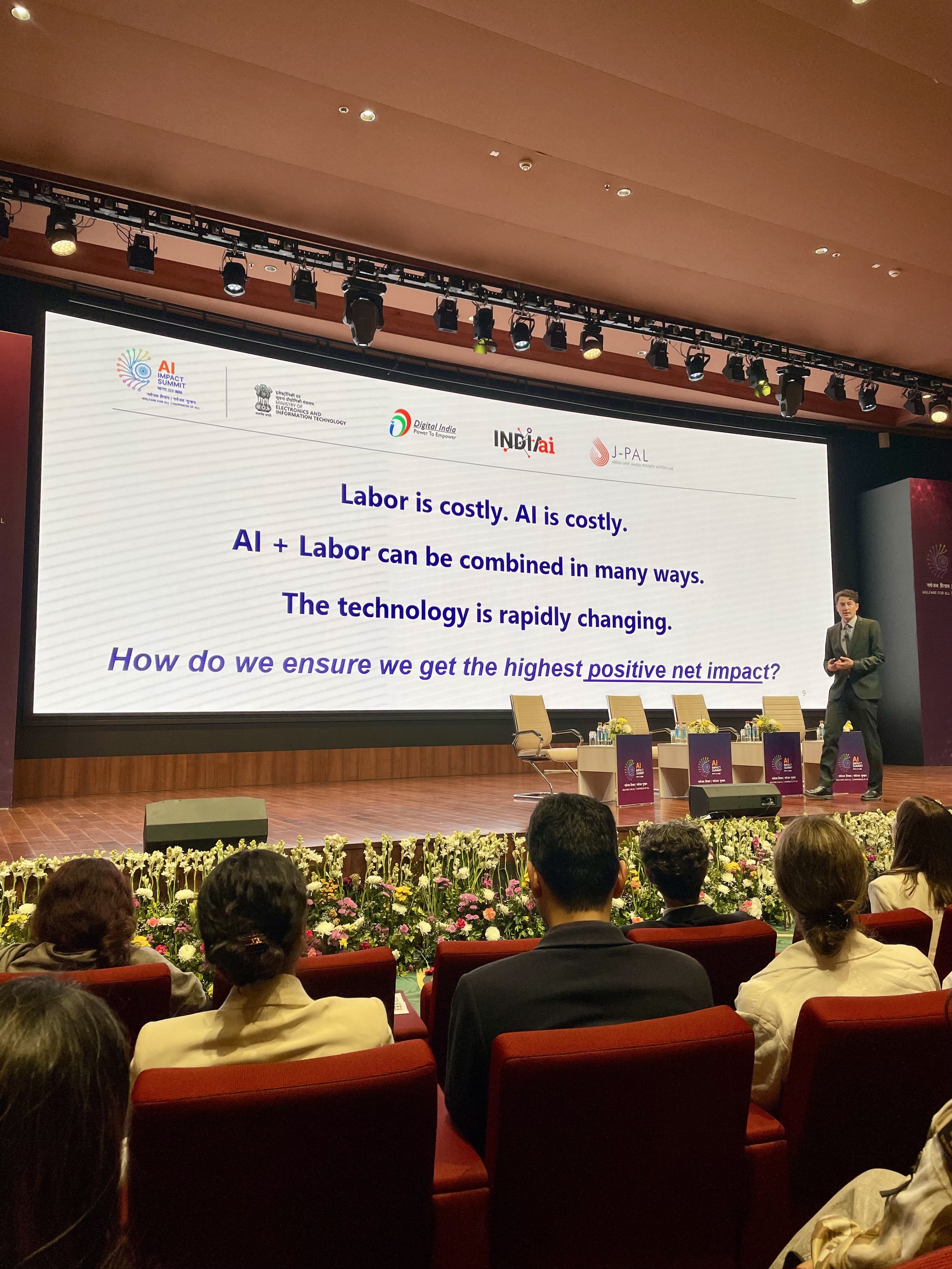
David Yanagizawa-Drott, Professor of Economics at the University of Zurich and co-chair of J-PAL's AI Evidence Initiative, opened his session at the India AI Impact Summit 2026 with a request. Think of the one thing you want AI to do in your organisation. Is that automation or augmentation? What evidence does that choice rest on?
He guessed that most people in the room based their choice on no rigorous evidence at all. The technology is new. Few organisations have properly evaluated different approaches, and even fewer have published the results.
That is the evidence gap. Every organisation deploying AI decides whether to replace a human decision or support it, with almost no empirical basis for the choice.
What the room assumed
Yanagizawa-Drott set a scenario. You run district hospitals in Uttar Pradesh. AI can fully automate diagnosis, cutting labour costs by 20%, or assist doctors, cutting costs by 5%. Which do you choose?
90% of the room chose augmentation. The intuition is strong: keep people involved where stakes are high.
He then added hypothetical outcome data. Automation produced 30% worse health outcomes; augmentation, 5% worse. Augmentation still won, but support for keeping doctors alone rose. Where the line falls depends on an organisation's values. The point was that the room decided with numbers in hand. Real organisations rarely have them.
When augmentation came last
He then presented a randomised experiment with an organisation in Ghana that recruits university graduates to teach in rural areas. Experienced teachers screened applicants. The question was whether GPT-4 could improve selection, either by deciding alone or by advising the human screeners.
The expectation, his own included, was that the combination would win. It did not. Full automation improved hiring success by about 70%. The assisted approach performed worst. The AI's suggestions slowed the screeners without meaningfully changing their decisions.
One study does not settle the question. The answer depends on the task, the skill of the people involved, the capability of the system and how they interact. But as Yanagizawa-Drott put it, an organisation cannot stop at "it depends". It has to choose, and it should choose on evidence from its own context.
A third option: capability that did not exist
Shankar Maruwada of the EkStep Foundation widened the frame. AI also creates capabilities that were simply not available before. Amul, the world's largest dairy cooperative, launched an AI advisory in Gujarati in February, giving women farmers access to decades of the cooperative's knowledge by voice, in their own language. A job-matching pilot in Ghaziabad surfaced 4,000 openings in a district where existing platforms listed 10. Scholarships for girls with disabilities reached recipients in 20 minutes rather than 6 months, because the system found eligible applicants instead of waiting for them.
These are neither automation nor augmentation. They are new reach.
Where the gains concentrate, and who is missing
Elizabeth Kelly of Anthropic shared figures from the company's Economic Index: India ranks 2nd in total AI usage but 101st of 116 countries per head, with use concentrated in technology work. Dr Becky Seif of the UK's FCDO raised the inclusion gap, citing research that women are about 20% less likely than men to use generative AI at work, and argued for designing inclusion in from the start.
Kelly also separated efficiency from growth. Efficiency makes existing tasks faster and cheaper. Growth lets people and organisations do what they could not do before. When AI drives growth, the opportunity expands for everyone involved.
Measure before you scale
The session converged on evaluation before scale. Seif outlined FCDO's framework: assess the model, the product, the user experience and the development impact, after first asking whether AI suits the task at all. Evidence, she argued, is what builds trust in a field where hype and fear sit side by side.
Building evidence in your own organisation
Define the task and the alternatives: automate, assist or leave as is.
Measure the baseline before anything changes.
Compare on real cases, not curated ones.
Measure quality, speed, cost and who benefits, including the people doing the work.
Decide, then keep measuring, because the right answer can change as systems and people learn.
How Mitochondria's agentic AI systems are deployed on evidence
The approach. No deployment commits to automation or augmentation in advance. The first stage maps how the work is actually done. The system then starts with a defined scope, and records and evaluates every interaction before the scope widens.
What it enables. Each stage produces evidence: which cases the system handles well, where a person's judgement adds most, and where new capability appears that nobody planned for. Autonomy grows only where that evidence supports it. In regulated settings, such as investor services under SEBI, this rigour is required; in every setting, it is sound practice.
The impact. Decisions about people and AI rest on the organisation's own data, not on instinct. Risks surface early, when they are cheap to fix. And the business case for each next step is already written by the results of the last.
Read more about Mitochondria's approach.
Sources
Sessions at the India AI Impact Summit 2026, New Delhi, as presented by: J-PAL AI Evidence Initiative, EkStep Foundation, Anthropic and FCDO
—
Mitochondria builds agentic AI for evidence-led core operations. Research-led and model-agnostic. ISO/IEC 27001:2022 certified, with controls aligned to the GDPR, UK GDPR, India's DPDP Act and Australia's Privacy Act. Amsterdam and Pune. Request a working session →