

courtesy: GIIC
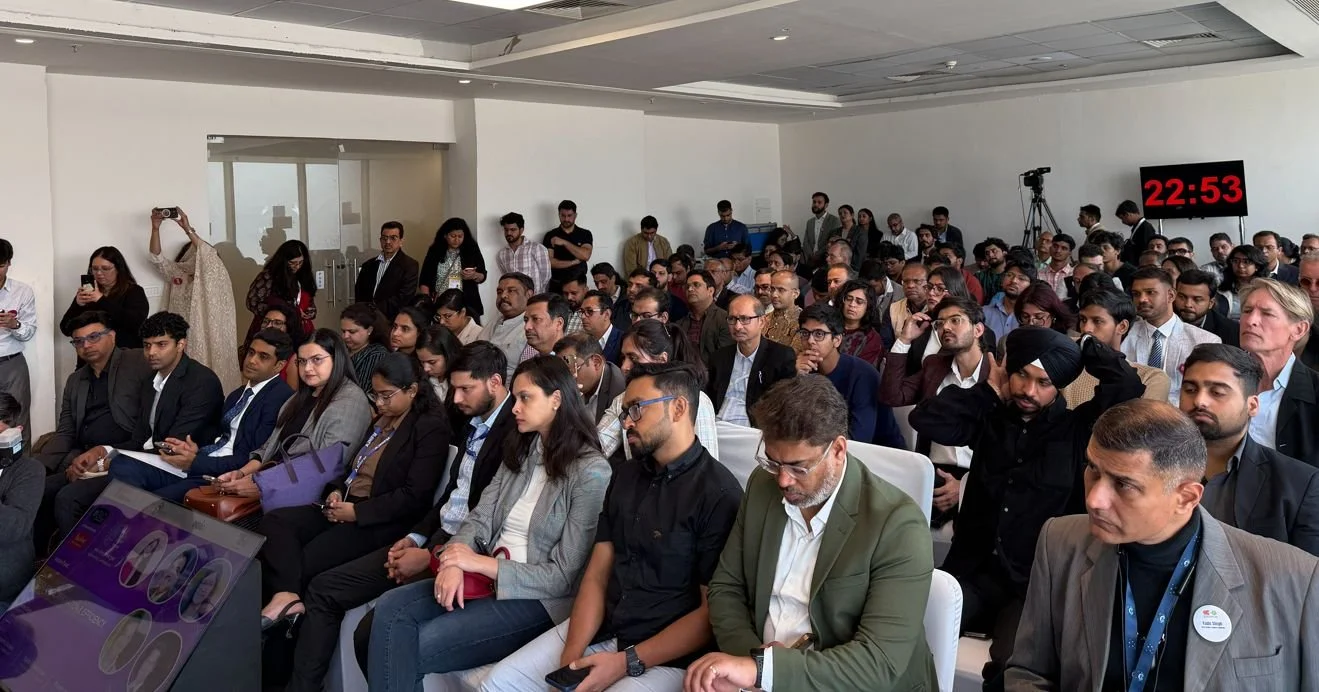
One number from the India AI Impact Summit 2026 deserves attention from anyone serious about industrial AI. It came from an SAP and Oxford Economics survey, shared at a session on AI for industries convened by the German Indian Innovation Corridor (GIIC) at Bharat Mandapam, New Delhi.
9%. That is the share of organisations that describe their approach to AI as holistic.
Adoption is not the problem. In Indian organisations, 23% of business processes are already AI-supported, and leaders expect that to reach 41% within 2 years. 93% of CXOs and CEOs surveyed expect positive returns on AI within 1 to 3 years. The confidence is there. The architecture is not.
That gap ran through a session that brought together SAP, Siemens, Curebay, Vahan AI and the GIIC. Each panellist came from a different sector. The diagnosis was the same.
Pilots underwhelm because value compounds later
Clas Neuman of SAP drew a line between consumer AI and enterprise AI. Consumer AI is the light bulb: visible and instant. Enterprise AI is the power plant behind it. A light bulb needs a socket. A power plant needs architecture.
The survey supports him. 72% of respondents said they are still not ready with their data. And organisations that have moved past pilots report that returns are non-linear: modest at first, compounding later, but only when the foundations allow it.
That is what makes the pilot-to-production step so hard. A pilot is judged on its modest early results. The larger value only appears when AI runs across processes rather than inside one department, and most organisations are built in vertical silos. Embedding AI across them is an organisational design problem before it is a technology one.
Neuman proposed an IMPACT framework for scaling: infrastructure and interoperability, measurable outcomes, policy and guardrails, AI as a horizontal layer, technical centricity, and talent.
The factory floor is unforgiving
The Siemens speaker made the same point from the plant. AI now produces impressive prototypes easily. Making them robust in production is a different discipline. A prototype that fails under real load is worse than none, because it spends the trust the next system will need.
He also described a change in who does the work. People on factory floors now work alongside collaborative robots, agents and intelligent systems. Siemens framed this as an opportunity, one that needs investment in vocational training and a shift from being AI-ready to being AI-native.
Where trust is the product
Two panellists showed what careful design looks like when stakes are high.
Priyadarshi Mohapatra of Curebay described healthcare for rural India, where most primary health centres outside the largest cities are short of staff. AI screens and stratifies risk, for example through photo-based screening for early oral cancer. Qualified doctors in physical clinics make the clinical decisions. His four principles: trust, transparency, translation and texture.
Madhav Krishna of Vahan AI described blue-collar hiring, where trust runs through hundreds of thousands of local recruitment agencies. Vahan's AI recruiter works alongside 3,000 human recruiters in more than 900 cities, screening and answering questions in several Indian languages. When a candidate disengages, a person steps back in. Krishna said a recruiter who placed 1 person a day can now place 5, with a target of 50.
Both cases share one principle. In complex, trust-dependent settings, AI works as a layer inside existing human systems and earns autonomy step by step.
The corridor between Europe and India
Upen Barve of the GIIC described a corridor linking European and Indian innovation: scouting, deep tech hubs, think tanks and landing pads. Germany brings manufacturing depth and regulatory maturity. India brings speed, digital scale and a young workforce.
The EU AI Act and India's DPDP Act differ in detail but share a commitment to responsible deployment. For companies working across both, building systems that meet European governance and still deploy at Indian scale is a real and valuable capability, and it has to be designed in from the start.
Krishna added a point that matters here. Most online content is in English, and most Indian languages have a small digital footprint. Whoever solves multilingual AI for India builds capability that travels to any multilingual market.
What has changed since the summit
Rockwell Automation's 2026 State of Smart Manufacturing report, published in May, surveyed 1,560 manufacturers across 17 countries. 59% now actively use smart manufacturing technologies in operations; only 18% remain in pilot mode. On average, 34% of operations are AI-augmented, and manufacturers expect more than half to be AI-supported by 2030. In Asia Pacific, only 42% of collected data is used effectively.
The direction is clear. Manufacturers are moving from pilots to production. Data foundations and architecture still decide who gets there.
courtesy: GIIC
What this means for manufacturers
The session matched what manufacturers describe every day. A common case is evaluation and costing that depend entirely on a few senior engineers, with nothing recording how they decide. Junior engineers take far longer on the same evaluation, because what makes the difference lives in experience. Which questions to ask. Which parameters to check. Which material and process combinations to consider.
Mitochondria's agentic AI systems address this horizontally, inside the workflow. They organise the incoming documents, guide the engineer through the decisions, and keep the reasoning as the work is done. Deployment is phased, and autonomy grows only as reliability is shown. Senior engineers spend their time on judgement. Juniors work with structure that experience used to take years to build. The business stops depending on who is available.
From adoption to integration
Srinivasan Ravindran closed with a call to move from AI adoption to AI integration. Adoption acquires capability. Integration builds it into how an organisation runs: in manufacturing, healthcare, energy and logistics.
The 9% figure is a challenge. For organisations willing to do the architectural work, it is also an opening. 91% have the confidence. What they need is the architecture to match.
Five tests before scaling an industrial AI pilot
Data: is the data the system needs available, current and owned? The SAP survey found 72% of organisations still not ready.
Scope: does the process cross departments, and has each one agreed how it will change?
Ownership: is there a named owner for results, not only for the technology?
Measures: is success defined in business terms, such as cycle time, margin or quality, before go-live?
People: are training and oversight planned for the people who will work alongside the system?
How Mitochondria's agentic AI systems help manufacturers move past pilots
The approach. Each unit is deployed in four stages, mapping the real operation first and widening autonomy only as reliability is shown. It runs horizontally inside the workflow, across sales, engineering and compliance, rather than as a tool in one department.
What it enables. Quotes, technical offers, costing evaluations and drawing change control (units 61, 62, 63 and 65) that hold up in production, with a named person at every binding step and a full audit trail.
The impact. AI that delivers in production rather than in pilots, built on data foundations the deployment itself puts in place.
Read more about manufacturing.
Sources
SAP and Oxford Economics survey, as presented at the India AI Impact Summit 2026 (GIIC session, Bharat Mandapam)
Rockwell Automation, 2026 State of Smart Manufacturing report (press release)
—
Mitochondria builds agentic AI for evidence-led core operations. Research-led and model-agnostic. ISO/IEC 27001:2022 certified, with controls aligned to the GDPR, UK GDPR, India's DPDP Act and Australia's Privacy Act. Amsterdam and Pune. Request a working session →