
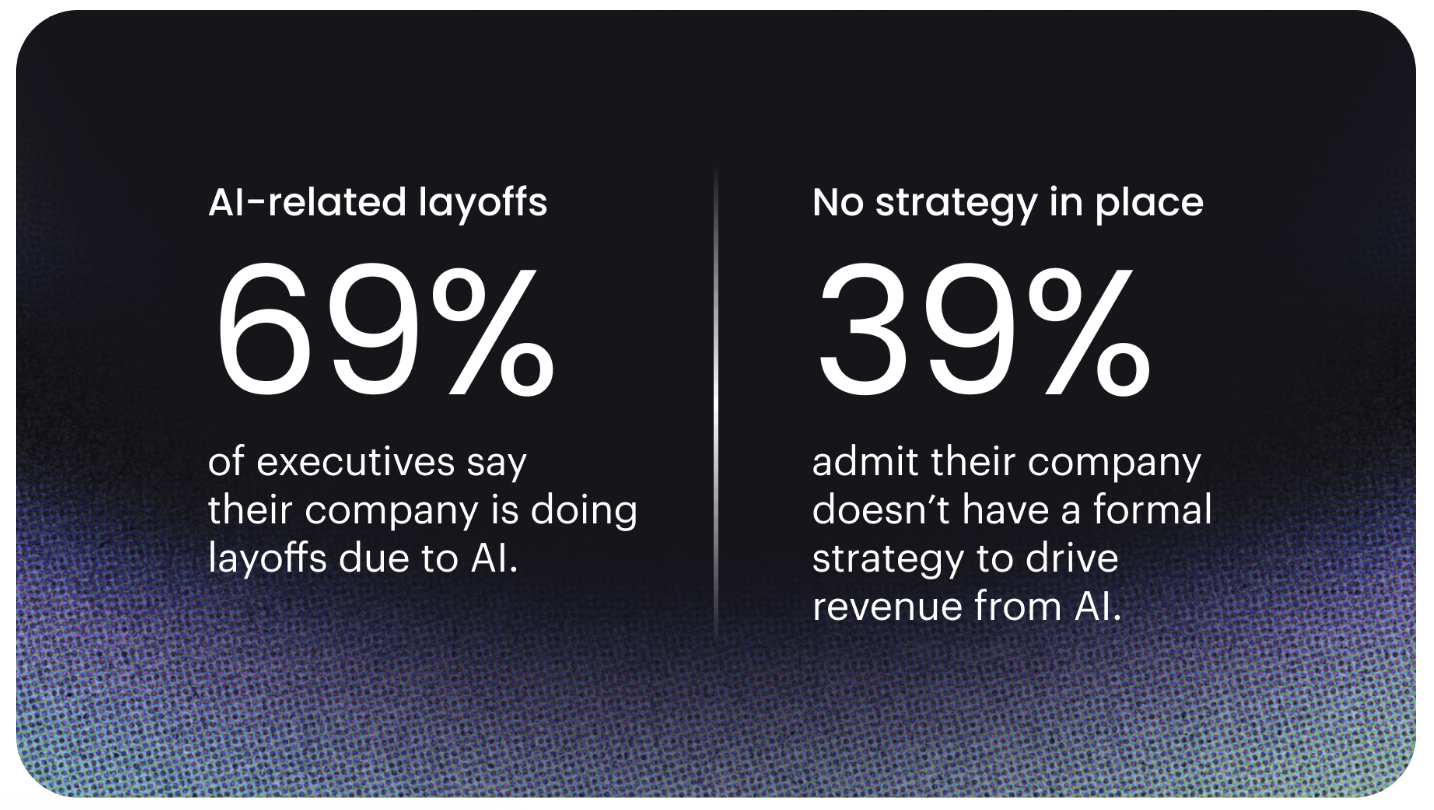
courtesy: writer.com / Enterprise AI adoption in 2026
48% of executives describe their company's AI adoption as a massive disappointment, up from 34% a year earlier. Only 23% report significant returns from AI agents. Both figures come from Writer's 2026 Enterprise AI Adoption survey, conducted with the research firm Workplace Intelligence across 1,200 executives and 1,200 non-technical employees. The same survey finds that 97% of those executives deployed AI agents in the past year, and that the individuals using these tools report genuine productivity gains.
Hold those findings together and the shape of the problem changes. Deployment is nearly universal. Individual gains are real. Returns at the organisational level are thin. Wherever the value is leaking, it is leaking somewhere between the person using the system and the enterprise measuring the result.
Deloitte's State of AI in the Enterprise 2026, a survey of more than 3,200 business and IT leaders across 24 countries, locates the leak. 84% of organisations have not redesigned jobs or workflows around AI capabilities. Employee access to sanctioned AI tools rose 50% in a single year, reaching roughly 60% of workers, while the organisational structures around those workers stayed as they were. The systems arrived. The work did not change to receive them.
What an unredesigned workflow costs
Consider a concrete case, close to work we see often. A system now assembles the first draft of a technical offer, a task that previously took a senior engineer three weeks of gathering specifications, checking pricing against current rates, and formatting the result for a client. The system does this in minutes, and does it well.
If nothing else changes, here is what the organisation actually bought. The approval chain still routes the draft through the same four desks in the same order, because the workflow was designed around a three-week production time and nobody revisited it. The senior engineer still owns the task on paper, so she reviews the draft with the same thoroughness she applied to her own work, which is prudent for the first month and habit after that. Her role description still lists offer preparation among her duties, so her capacity was never reallocated. Procurement counts the licence cost. Finance looks for the saved three weeks and cannot find them, because the weeks were never removed from the process, only from one step inside it.
Multiply that pattern across every function that adopted a tool this year and the survey results stop being surprising. The organisation pays for the system and for the process the system was meant to replace, and banks the savings of neither. Deloitte's production figures show the aggregate: only 25% of organisations have moved at least 40% of their AI experiments into production. The experiments were sound. There was no redesigned process waiting to receive them.
The ownership gap underneath
Writer's survey identifies a second pattern feeding the first. Organisations tend toward one of two failure modes: locking AI inside technical teams, which creates bottlenecks that starve adoption, or permitting unsanctioned tools to spread faster than IT can govern them. The survey frames the structural requirement both modes violate: business teams need direct ownership of AI workflows, while IT holds centralised control over how those workflows operate.
The root is the same in both modes. The people who own the workflow were never made owners of the system that changed it. A tool procured by IT and used by operations belongs, in practice, to nobody. Nobody adjusts its boundaries when the work shifts. Nobody answers for its output in the meeting where output is discussed. Nobody fights for it in the budget round. Systems that belong to nobody are demonstrated in the first quarter and quietly abandoned by the third, and the executive who approved the spend records the experience, accurately, as a disappointment.
Four fixes, all organisational
Nothing above is repaired by a better model. The repairs sit in process, ownership and management, which is uncomfortable news for organisations that prefer buying software to changing roles, and encouraging news in every other respect, because all four are within reach of any leadership team willing to treat AI adoption as an operational change rather than a procurement.
Redraw the workflow before the system lands. Some steps exist only because human memory and attention are limited. A checking step that guards against transcription errors has no purpose once nothing is transcribed by hand. A weekly status meeting that existed to synchronise information has no purpose once the information synchronises itself. Automating a step that should have been removed preserves waste at higher speed. The honest sequence is to redraw the process around what the system makes possible, retire the steps that no longer earn their place, and only then decide where the system runs. Deloitte's finding that 84% skip this stage is, read optimistically, a list of quick wins still on the table.
Put ownership where the work lives. The team whose output changes should hold the system: set its boundaries, tune its behaviour within governed limits, and answer for its results, with technical colleagues supporting rather than gatekeeping. This assignment should be explicit, named, and visible in the same places other operational responsibilities are visible. It is the single difference between a tool that gets adopted and a tool that gets demonstrated.
Bring the middle layer into the redesign. Supervisors and team leads decide, through a hundred small daily signals, whether a system becomes part of how work is done or remains an official fiction everyone works around. They are routinely the last to be consulted and the first to be blamed. Involving them at the redesign stage, where their knowledge of how the work actually flows is the scarcest input available, costs a few workshops and changes adoption outcomes more than any feature roadmap does.
Measure a rate, not a moment. A demo proves possibility once. What matters is performance across ordinary weeks on ordinary inputs, reviewed on the same rhythm as any other operational metric, with someone accountable for the number. Organisations that hold their systems to an operating rhythm keep them alive and improving. Organisations that judged the system once at launch, then stopped looking, are heavily represented among the 48%.
What we might be wrong about
Our working view is that this redesign cannot simply be bought in from outside. An external team can map the process, propose its new shape, and build the system that serves it; that is much of what we do. But the ownership shift at the centre, deciding that an operations team now holds a system and that a senior role now means something different, has to be made inside the organisation, by people with the standing to change what roles mean. Whether that decision can be prompted from outside, or only recognised where leadership was already prepared to make it, we do not yet know. We are watching our own engagements for the answer, and will write about what we find.
—
Mitochondria is an agentic AI product company based in Amsterdam and Pune. ISO 27001:2022 certified. Designed to fall within the limited and minimal risk tiers of the EU AI Act, with controls aligned to the GDPR, UK GDPR and India's DPDP Act.